





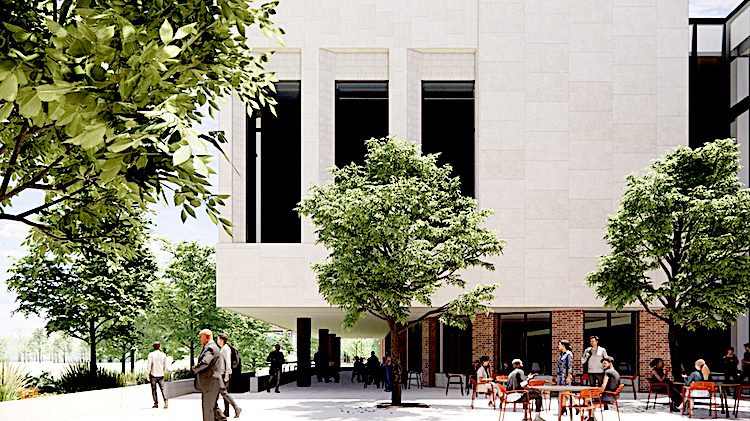
An artist’s rendering of the new building at Rice Business to open next year
GROWING FACULTY AND RESEARCH
Under Rodriguez’s leadership, the school’s faculty has expanded dramatically. Tenure-track positions have grown by nearly 50%, with similar increases among non-tenure-track faculty. “We finally have strong groups in strategy, finance, marketing, and accounting,” he says. “We added PhD programs in organizational behavior and operations research, alongside our long-standing tracks in accounting, finance, and strategy.”
The PhD population has doubled—from roughly two dozen students when he arrived to nearly 50 today. “That’s been a big part of our research growth,” Rodriguez notes. “We’re doing much more high-quality, high-impact research, and that allows the faculty to do even more.”
Perhaps his boldest move came next: creating Rice’s first undergraduate business major. “Rice has extraordinarily talented undergraduates,” Rodriguez says. “But they were trying to piece together business education wherever they could—through managerial studies in social sciences, sports management, or an investment banking practicum.” It reminded him of Dartmouth, where students “essentially created their own business majors” through a patchwork of economics and management courses.
OVERCOMING RESISTANCE TO AN UNDERGRADUATE BUSINESS MAJOR
 The idea initially faced resistance. “No one would have voted for it in the beginning,” he admits. “Faculty asked, ‘How will we be compensated for teaching undergrads?’ and the answer was—we wouldn’t be, at least not right away.” But university leaders and board members began to see the logic. “They knew students who wanted business were going to Penn, Cornell, Berkeley, or McCombs. We could make the case that Rice should be an option too.”
With presidential support, the plan moved forward—slowly at first. “We started small in the fall of 2021 with just a couple of classes,” Rodriguez says. “By 2022, the program was up and running, and it was instantly popular. Many students had no idea they could major in business, so the ones who switched were true believers. Even music majors switched.”
By 2023, demand was undeniable. “Our freshman surveys showed more students expressing interest in business than any other field,” Rodriguez says. Today, 600 to 650 undergraduates—roughly 11 to 13% of the university’s 1,250-student class—are majoring in business. “We’re in high demand,” he says. “We have room to innovate, and the new building will help.”
A NEW ERA FOR GROWTH
The new building, opening this spring, will expand Rice Business’s physical footprint by nearly two-thirds. It will feature seven classrooms—including several tiered lecture halls seating 65 to 120 students—and bring the school’s total to 21 or 22 full-time classrooms. “When I started, we had just under 500 degree-seeking students,” Rodriguez says. “This year we’ll surpass 1,700.”
That growth reflects an extraordinary transformation: from a single MBA program to a full portfolio that now includes online, professional, and undergraduate degrees, as well as renewed master’s and doctoral offerings.
Even the flagship full-time MBA has evolved. “Our view has always been that one of the biggest values of an MBA is the network you build,” Rodriguez says. “I didn’t think we needed to stay as small as we were.”
EXPANDED FULL-TIME MBA PROGRAM AS MANY OTHER SCHOOLS LOST ENROLLMENT
Enrollment in the full-time MBA has grown from 70 to 110 students, expanding from two sections to three. That growth occurred as most other schools have seen dwindling interest and enrollment in their residential MBAs. “The full-time program isn’t a moneymaker,” Rodriguez notes, “but we believed we had the resources to grow it. Our alumni base has doubled in size. That network now extends across cohorts and programs in a way it never did before.”
Under Rodriguez’s leadership, Rice Business has emerged as one of the most dynamic and fastest-growing schools in the nation. What began with a listening tour and a promise to “start doing things” became a full-scale transformation of a school once considered under the radar. Today, its footprint—both literal and figurative—has expanded across the university, the city of Houston, and the broader business education landscape.
As artificial intelligence reshapes the world of work, Rodriguez sees opportunity rather than threat. “I think we’ll be fine,” he says. “The job destruction talk is probably a little overhyped. Giving AI skills to all our students is extremely important—we want them to get the right dosage, to be discerning, critical, and in command of a great toolkit. That’s what they’ll have when they leave here.”
‘I BELIEVE IN WHAT I’M DOING’
Looking ahead, Rodriguez shows no signs of slowing down. “What’s next? All of the above,” he says with a grin. “One of the worst things you could do to me is make me go back to a classroom in blue jeans to teach. I love being a dean. I believe in what I’m doing. You cherish your scars and how you won them. Being a dean is a great job, for sure.”
For Rice Business, those words ring true. Under Rodriguez’s steady, forward-looking leadership, the school has grown in every direction—programs, faculty, facilities, and reputation—without losing its intimate, student-centered soul. His tenure stands as a model of how courage, vision, and care can transform a school. That’s why, in 2025, Peter Rodriguez is Poets&Quants’ Dean of the Year.
© Copyright 2026 Poets & Quants. All rights reserved. This article may not be republished, rewritten or otherwise distributed without written permission. To reprint or license this article or any content from Poets & Quants, please submit your request HERE.


