






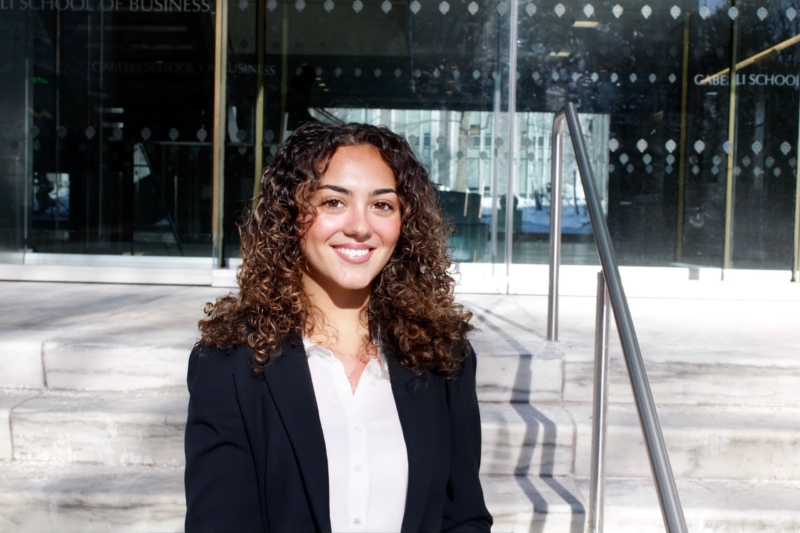
MacKenzie T. Brown, Fordham University (Gabelli)
6) The Mess Makes You Better: “Business school taught me how to make decisions in uncertain situations. I walked into business school thinking that there were explicit formulas to solve problems: enter the numbers into the equation, run the analysis, and get the correct answer. Instead, I found that real-world business problems are messy. The data is often incomplete, the stakeholders have different ideas and goals, the market is constantly changing, and the clock is always ticking. Through case studies, simulations, and consulting projects at Fordham, I learned how to ask questions, develop hypotheses, test assumptions, and press forward—even when the answer isn’t clear. More importantly, I learned to articulate recommendations in a way that makes sense, be receptive to feedback, and adjust when new information becomes available. This skill—thinking critically in uncertain situations and acting with confidence—is the most important thing I have learned in business school.”
MacKenzie T. Brown, Fordham University (Gabelli)
“The biggest lesson I have learned studying business is that there is no single right answer. It is not a math problem with one clean solution. It is people, each one with a different background and motivation, trying to build something meaningful. The real advantage comes from understanding that business is a people’s game. When you connect, listen, and give without expecting anything in return, trust builds and success tends to follow.”
Carl Firch, Southern Methodist University (Cox)
7) Start With Knowing Your Business: “At my P&G Internship, I was told that the #1 thing I needed to do was “know your business”. At the time, I took this to mean understanding the data and trends of my isolated job. As I’ve grown over this past year, I’ve realised it has a much greater meaning. “Know your business” means understanding the living system your work operates within, the individual goals and relationships within the system, and how your personality and workstyle can fit in to maximize the team goal. This lesson is all about context, ownership, and self-awareness.”
Nikki White, Miami University (Farmer)

Cristina Grace Liberto, Indiana University (Kelley)
8) Pressure Is What You Make It: “My biggest lesson is that pressure does not have to equal stress. It’s about how you frame the situation in your mind. The solution to my low mood wasn’t to push away the pressure, but to see my challenges as opportunities. As the years went on at Kelley, I’ve reframed my thinking to be grateful for my everyday pressures, which have made all my learning more fun. It has even pushed me to do more, all with a smile now.
As I enter my career, I know new pressures will emerge, and they’ll require continued reframing. I’m both nervous and excited, knowing this mindset will help me learn faster and maintain perspective. My advice to incoming business students is to adopt this mentality early. Instead of wishing demanding school weeks go away, savor them recognizing that you’re training valuable skills from time management to composure under pressure that will compound for the rest of your career.”
Cristina Grace Liberto, Indiana University (Kelley)
9) Don’t Wait For Opportunities: “The biggest lesson I learned is that opportunities do not come from waiting; they come from initiative and consistent effort. During my sophomore year, I realized I was underusing the resources around me. I had access to professors, alumni, student organizations, and career programs, but I was hesitant to fully engage because I did not feel ready. At that point, I decided to be more proactive. I started attending networking events regularly, reaching out to alumni for coffee chats, applying to competitive programs, and stepping into leadership roles even when I felt underqualified.
Many of those early efforts did not lead to immediate success. I faced rejections and unanswered messages, but I stayed consistent and continued improving my approach. Over time, I began to notice small shifts. Some conversations led to follow-up calls. A few applications turned into interviews. I learned that growth often comes from stepping forward before you feel fully ready and trusting the process when outcomes are not immediate.”
Steven Preval, Rutgers Business School (Newark)
10) Create A Personal Brand: “The biggest lesson that I’ve learned from studying business is how important it is to create a professional brand and cultivate your communication style to fit that image. Combining my knowledge from both management-focused courses, like Leading People in Organizations, and humanities classes on public speaking have allowed me to become a more effective leader and communicator. I have used these skills to propel my leadership in student organizations and will continue to use this brand in my career after graduation.”
Kensington Zwerner, Rice University (Virani)
“Studying business has taught me that who you are matters as much as what you know. Business is all about making and sustaining relationships, so being trustworthy, genuine, and easy to work with is what truly sets people apart. It’s also imperative to have strong values and guiding principles to shape how you make decisions, treat people, and handle pressure. Many of my mentors and those whom I admire are not only incredibly intelligent, but they’re also reliable and operate with integrity and empathy. Over time, that consistency builds trust, and trust is the foundation of every meaningful business relationship I’ve seen.”
Aurrel Bhatia, Northeastern University (D’Amore-McKim)

Ty Keough, USC (Marshall)
“Trust is the real currency. You can build the sharpest valuation model, craft the perfect pitch deck, or design an innovative product, but if people don’t trust you to execute, none of it matters. I learned this teaching since I was a freshman, pitching to billionaire CEO, and building AI tools that people actually had to rely on. Competence gets you in the room. Integrity and follow-through keep you there.”
Ty Keough, USC (Marshall)
11) Find People Who Balance Out Your Weaknesses: “The biggest lesson I’ve learned studying business is “you’re not the best”. You are not the best at everything, and you are not meant to be. Early on, I believed success came from relying on myself and trying to excel in every area. Studying business taught me that the strongest organizations are built on teams where people bring different strengths, perspectives, and expertise. No single person has all the answers. True success comes from knowing when to rely on others, valuing their contributions, and working together toward a shared goal. This lesson taught me humility and showed me that leadership is not about being the smartest person in the room, but about empowering others and trusting the collective strength of a team.”
Susan Liu, Texas A&M (Mays)
12) Ideas and Authority Only Go So Far: “The biggest lesson I gained from studying business is how essential effective communication is. One of the most valuable aspects of Neeley’s curriculum is the consistent emphasis on group work. Nearly every business class I have taken has involved collaborating with others, often across multiple projects throughout the semester.
Through these experiences, I have learned that strong ideas only go as far as your ability to communicate them clearly and work through them with others. Embracing group work has helped me better understand my own working style, including where I communicate well and where I still have room to grow. It has challenged me to listen more carefully, accept feedback, and embrace different perspectives.
Beyond building self-awareness, it has also taught me how much I rely on others to produce meaningful work. I have come to appreciate that success in business is rarely an individual effort. It depends on how willing you are to learn from others and work alongside them.”
Katie Russell, Texas Christian University (Neeley)
Let’s make it a baker’s dozen…
13) People Are Motivated By Stories, Not Concepts and Commands: “Studying business taught me a great deal about economic principles, financial models, optimization algorithms, and behavioral theories—each being a fundamental aspect of one’s business acumen. However, I have learned that the true differentiator of successful business leaders is effective and transformative storytelling. While numbers and analysis are critical to arriving at correct and defendable solutions, they alone are not sufficient for building the buy-in necessary to execute a vision. It is how you incorporate them into a clear, cohesive, and inspirational story that truly matters.
The most prominent business leaders don’t lead through command; rather, they lead through inspiration. To inspire, they share visions through stories grounded in empathy and narratives that resonate directly with their audiences. I’ve learned that storytelling is what turns a business goal into a shared purpose, making you a far more effective leader. As I move into the workforce, I look forward to further honing my storytelling skills and one day inspiring others.”
Noah George, USC (Marshall)
DON’T MISS: 100 BEST & BRIGHTEST BUSINESS MAJORS OF 2026
© Copyright 2026 Poets & Quants. All rights reserved. This article may not be republished, rewritten or otherwise distributed without written permission. To reprint or license this article or any content from Poets & Quants, please submit your request HERE.


