






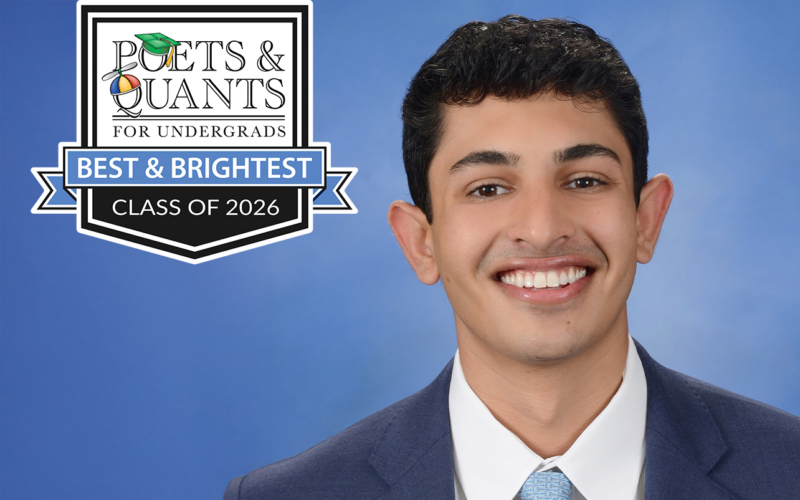
Cole P. Cherian
University of Notre Dame, Mendoza College of Business
“Mission-driven finance student and social entrepreneur growing the good in business.”
Fun fact about yourself: I embrace calculated risks: I’ve freedived with tiger sharks and skydived from 13 000 feet, experiences that taught me to seek growth outside my comfort zone.
Hometown: Ardmore, Pennsylvania
High School: Malvern Preparatory School
Major: Finance
Minor: Business and the Common Good
Favorite Business Course: Why Business?
Extracurricular Activities:
Mendoza Dean’s Ambassadors Council
Teaching Assistant for Maximizing Mendoza (BAUG 13100), Honors Corporate Finance (FIN 30402), Investment Theory (FIN 30600), Strategic Management (MGTO 30120), Social Entrepreneurship (MGTO 30510)
General Partner & Investment Committee Member, ND Venture Capital
Head of Growth @ Desi (Student-exclusive rideshare startup, now known as Yelo)
ND Student Government Department for National Affairs & Political Engagement
ND Student International Business Council (Evercore, GTCR, Battery Ventures Travel Teams)
ND Investment Club
Confirmation Sponsor, ND RCIA Short-Course
Service Commissioner, Dillon Hall
Awards:
Dean’s List (All semesters)
Mendoza Business Honors Program
2022 IDEA Center Fellow
Where have you interned during your college career?
Business Analyst Intern @ McKinsey & Company, Philadelphia, PA, Summer 2025
Investment Intern @ Silver Lake, New York, NY, Summer 2024
Finance Intern @ RenoFi, Philadelphia, PA, Summer 2023
Where will you be working after graduation?
Business Analyst @ McKinsey & Company, Philadelphia, PA
Who is your favorite business professor? Mary Hirschfeld, John T. Ryan Jr. Associate Professor of Theology and Business Ethics, is my favorite business professor because both her teaching and her academic work embody Mendoza’s distinctive mission to “Grow the good in business to improve the human condition in an ever-changing society.” Prof. Hirschfeld, who earned her Ph.D. in Economics from Harvard University and her Ph.D. in Theology from Notre Dame, is not only fluent in both business and integral human development, but also serves Mendoza students as a bridge-builder integrating both disciplines. Moreover, while she is a thought leader in the academic field of business ethics, her primary focus is her vocation of undergraduate teaching. Her greatest strength is her ability to make esoteric concepts accessible to intellectually curious students. She has also been a wonderful honors thesis adviser!
What is the biggest lesson you gained from studying business? The key takeaway from my study of business is that, in the words of Mendoza’s founding Dean, John Cardinal O’Hara, “The primary function of commerce is service to mankind.” In other words, Notre Dame has instilled in me the belief that businesses must be human institutions oriented towards the common good, through the creation of genuine, long-term value for society. Moreover, at the core of “genuine value” are the cooperative goods of good goods, good working, and good workers.
What advice would you give to a student looking to major in a business-related field? When I meet with Mendoza first-year students, I always recommend integrating their technical study of business with the broadening study of related, yet distinct, disciplines in the liberal arts or the sciences. At Notre Dame, my humanities-centered exploration of business ethics and political economy through the Business & the Common Good minor has richly animated my major in Finance. Additionally, I’ve taken several courses in both Italian Studies and Industrial Design, which have deepened my ability to solve problems creatively and with structure.
Looking back over your experience, what is the one thing you’d do differently in business school and why? It is a blessing to have very few regrets about the way I’ve approached my education. That said, one thing I’d do differently in business school would be approaching career discernment free from the pressure of figuring it all out. While Notre Dame offered me an exceptional environment and strong vocabulary with which I could discern my path in business, it was tempting to eschew an attitude of exploration in favor of anxiety about getting a job. When I fell into this trap, my faith, family, and friends helped me refocus on what was within my control: the process.
What is one way that your business school has integrated AI into your programming? What is one insight you gained from using AI? I am grateful that Mendoza has approached its AI policy with thoughtful nuance. Generally, AI is not only allowed, but deeply integrated into areas in which it is a valuable partner. For example, I am encouraged by my professors to use LLMs as research assistants for thesis discovery and as teaching assistants for exam preparation. Additionally, our Career Center encourages students to use LLMs for career path exploration. However, there are many areas in which AI usage conflicts with important learning goals and is therefore prohibited. For example, I have recently had fewer term papers than I used to being assigned. Instead, I have had more hand-written, in-class Blue Book essays to more accurately assess content mastery. Also, in true Notre Dame fashion, the University’s integration of AI into programming has been paired with constant discussion of its ethical considerations. One insight I gained from using AI is that LLMs are very good at prompting themselves. Given this, I built ChatGPT and Gemini agents that optimize prompts for me.
Which academic, extracurricular or personal achievement are you most proud of? The achievement I am most proud of is graduating from the University of Notre Dame. Each day at Notre Dame, I am inspired by the standard of excellence – both in academics and professional pursuits and in personal character – that is set for me by my classmates, teachers, administrators, and staff. I am proud that when I tell people I am a student at Notre Dame, their first thought is that I must be a person of character.
Which classmate do you most admire? I deeply admire my friend and classmate Jayden Bridgewater for his generosity, resilience, and gratitude. First, Jayden is one of the busiest students I know, particularly because he is so generous to others with his time and talent. At Notre Dame, Jayden uses his gifts to help others excel, both through individual mentorship and extracurricular activities, including service on the Dean’s Ambassadors Council and leadership in the Wall Street Club. Additionally, Jayden has a relentless drive, resiliently overcoming obstacles in his pursuit of excellence– personally, academically, and professionally. Finally, Jayden has an attitude of gratitude, which makes him an incredibly life-giving person to know as a classmate and friend. Truly, Jayden has had an inestimable impact on my life at Notre Dame.
Who would you most want to thank for your success? My younger sister Alessandra, a student at the University of Southern California, is my dearest friend and the person I would most like to thank. First, Alessandra’s focus on service inspires my approach to education and work. Moreover, growing up alongside an exemplar pushed me to pursue my own excellence. Finally, I am comforted by the knowledge that no matter what, Alessandra has always been and will always be in my corner.
What are the top two items on your professional bucket list?
1) Found, scale, and operate my own firm, putting into practice my framework for business as a force for good.
2) Open a morning-till-late espresso/aperitivo bar in Philadelphia.
What made Cole such an invaluable addition to the Class of 2026?
“I cannot say enough about Cole Cherian. It’s hard to imagine a more complete student. A 4.0 in one of Mendoza’s most difficult majors, Finance. An active and engaged member of Mendoza’s Business Honors Program. Writing an original senior capstone thesis on the improbable combination of Tolstoy’s Death of Ivan Ilyich and the new television series Severance, using them to examine the Marxian concept of “alienation” from work in a capitalist society.
As impressive as Cole’s technical skills are, they are equaled if not exceeded by his imaginative depth, his creativity, and his commitment to finding purpose in what he does. He reads widely, and he not only retains what he reads but he processes it. What wisdom can he mine from it? How does it relate to other things he’s read? How can it help him discern and pursue his calling?
In addition to these intellectual virtues, he is unusually committed to the success of others. He volunteers, he tutors, he mentors. He helps other students with their projects. One example: he has taken a genuine interest in and given excellent commentary on other students’ capstone theses, suggesting ideas to pursue, books and articles to read, and questions to consider.
Over this past Christmas break, he read an article about Adam Smith that was critical of Smith’s Wealth of Nations. He sent it to me, along with his thoughts, asking for my comments. This triggered a surprisingly deep discussion. Not for credit, not for a class: just because he wanted to learn and understand.
On top of all this, Cole is simply a genuinely good person. Always with a smile, always with a “how are classes going?” Always with an idea, book, or article to discuss. He is the type of student every professor cherishes, the type of student who elicits the best efforts not only from his fellow students but also from his professors.
It is hard to imagine a better representative of the best of Notre Dame business education. Cole will go on to do great things, with honor, integrity, and joy. We are, and will continue to be, lucky to count him among our own.”
James R. Otteson
John T. Ryan Jr. Professor of Business Ethics
Faculty Director, Business Honors Program
Mendoza College of Business
University of Notre Dame
DON’T MISS: 100 BEST & BRIGHTEST UNDERGRADUATE BUSINESS MAJORS OF 2026
© Copyright 2026 Poets & Quants. All rights reserved. This article may not be republished, rewritten or otherwise distributed without written permission. To reprint or license this article or any content from Poets & Quants, please submit your request HERE.


