



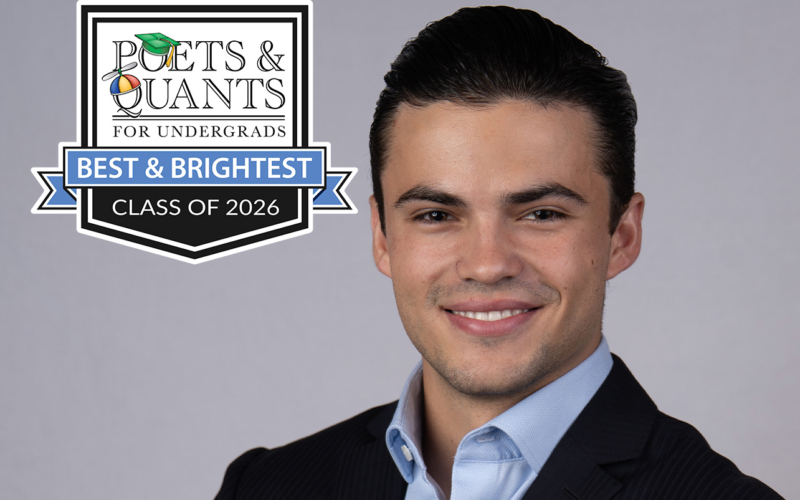
José Manuel Salazar Bogado
Trinity University, Neidorff School of Business
“Venezuela, China, Malaysia, Mexico, and the USA: a global citizen fostering leadership and adaptability.”
Fun fact about yourself: I practice guitar daily, working through the most technically demanding riffs from my favorite band: Polyphia.
Hometown: Caracas, Venezuela
High School: The American School Foundation, A.C. of Mexico City
Major: Business Analytics
Minor: Computer Science
Favorite Business Course: Data Science
Extracurricular Activities, Community Work and Leadership Roles During College:
Extracurriculars & Community:
- Alpha Kappa Psi – Nu Pi Chapter
-
- Membership Vice President (2023)
-
- President (2023-2024)
- Trinity University Data Analytics Club
-
- President and Founding Member (2024-2025)
- Trinity University Consulting Club
-
- Consultant – San Antonio Chamber Choir
-
- Consulting Director (2025)
- Interfaith Welcome Coalition
-
- Volunteer (2022-2023)
- Teaching Assistant – Data Science, Discrete Math
- Student Assistant – Trinity University Center for Experiential Learning and Career Success
Awards:
- Trinity University Business Analytics Dell Technologies Award for Academic Excellence 2025
- Dean’s List Fall 2023/2024, Spring 2024/2025
Where have you interned during your college career?
- Alpha Kappa Psi (2025-Present)
-
- Remote, USA – Alumni Directory Project Manager
- McKinsey & Company (Summer 2025)
-
- Austin TX, USA – Summer Business Analyst
- Dell Technologies (Summer 2024)
-
- Austin TX, USA – Undergraduate Business Intelligence Intern
Where will you be working after graduation?
- McKinsey & Company
-
- Austin TX, USA – Business Analyst
Who is your favorite business professor? Professor James Maxey taught me a lot of the technical and analytical skills that I use the most in my professional work in his Excel and Data Visualization courses. What made him the most impactful professor in my college career was not just what he taught, but how he taught it. Every class starts with a few dad jokes, so no matter how groggy I was from last night’s studying, I always started with a smile and a chuckle. He showed me that great teaching isn’t about credentials, it’s about caring deeply and equipping students with a toolkit that will outlast the classroom.
In all his explanations and lectures, he gives examples rooted in the real world and actual business problems he has faced in his career. That means classes and homework assignments feel less like an exercise and more like practice. Even beyond the classroom, running into Professor Maxey around Neidorff always means I have someone to chat with about extracurriculars or life. When he does stop you, he talks to you as if you are the only person in the room. It is rare to find a professor so personable that you find yourself wanting to take his courses twice just to spend another semester learning from him.
What I admire most about Maxey is his genuine love for teaching. As a retired industry professional, he has no incentive to continue teaching other than a true desire to support and develop his students. That desire is immediately evident in the way he can energize his classroom at 8:30am on a Monday. I am incredibly fortunate to have learned from him.
What is the biggest lesson you gained from studying business? The most important lesson I gained from studying business is to always seek to drive change. To do that, it is essential to never lose sight of the bigger picture and to always ask yourself, “So what?” As a business analytics major, it is incredibly easy to lose yourself in the intricacies of your machine learning model or Excel sheet, but as businesspeople, every task we do ultimately serves a larger purpose. Insight that does not drive action is just analysis. To create real value as part of an organization, the work you do should always be helping someone make a better decision.
Through my various analytics projects at Neidorff, I learned that technical skill alone is not what makes a great business professional. What sets you apart is your ability to derive action from complexity. You can build the best financial model or an impeccable balance sheet, but if you cannot take your output and create recommendations that drive lasting change, it has no impact.
Early on in my academic career, I often worked as hard as I could to arrive at the most technically sophisticated solution in the room. It was in my Data Science course when tasked with a case competition to help Sunoco LP predict gasoline demand that I came to the realization that what stuck the most with the judges was not the R2 of our model, but the actionable recommendations that came after. Ever since that project, the question of “So what?” drives everything I do.
What advice would you give to a student looking to major in a business-related field? Get comfortable with being uncomfortable. Having lived in five countries across three different continents, discomfort and novelty have been ever present. Learning to embrace that discomfort is what has taken me this far.
The moment you close yourself off to more challenging opportunities is when you stop learning and growing. I can say with certainty that the catalyst in my journey that brought me to where I am today is when I made the conscious decision to never say “no” to that next opportunity. Every time I have started something new, I have felt unprepared and questioned whether I had hit my breaking point.
When I ran for President of Trinity’s twenty-member chapter of Alpha Kappa Psi, I felt completely overwhelmed and out of my element. The learning and growth that came from saying yes to that opportunity is one of the best things that has happened to me in my academic career. Discomfort is not a warning sign; it is evidence that you have done the right thing and taken a step beyond where you are now. That discomfort was ultimately what gave me the confidence to feel like a leader and serve the organization, growing its membership to over sixty students in one year.
Looking back on my four years at Trinity, I have come to realize that with each moment of self-doubt, I have moved forward with a greater confidence in myself. So that when the next opportunity presents itself, I am ready to say “yes”.
Looking back over your experience, what is the one thing you’d do differently in business school and why? A business degree is a toolkit: what you build is up to you. I wish that I had experimented more with mine early on in my college career. I have been extremely fortunate to have matriculated at Neidorff and learned all the indispensable skills its programs have to offer. Early on in my university career, I was so focused on following a specific path that I did not experience the breadth of experience a Neidorff education has to offer.
Being a Business Analytics major, I thought that my skills were going to funnel me into data science or software development. It was not until after my sophomore year that I was introduced to consulting by my roommate. Now, having worked at McKinsey and Dell Technologies alike, I realize that skills can be transferred if you are willing to adapt and continue learning.
As I reflect on my time at Trinity, I would have embraced the option to test and learn about different career paths earlier. Business school is a truly unique place in the way it allows you to explore so broadly before committing so deeply.
What is one way that your business school has integrated AI into your programming? What is one insight you gained from using AI? One of the great things about being a Neidorff student, especially a Business Analytics major, is that not only are we at the forefront of understanding AI and its use cases, but we also learn how it works. Through our courses in machine learning, data science and business analytics we are taught to look under the hood of the models that power the most innovative systems in the world.
One of my favorite projects was a consulting case with Sunoco LP where we were tasked with identifying predictors of gasoline demand. My team employed a variety of models such as XGBoost, Random Forest and even a convolutional neural network to identify the most powerful predictors. Getting the opportunity to create our own datasets, build and refine our models, and utilize them to extract actionable insights gave me a much more profound understanding of how AI is used in context. It was then that I understood having a truly AI-native major means that we gain a unique perspective that goes beyond understanding the power of AI: we understand its applications and limitations. As I discovered in working on the Sunoco LP project, having a robust dataset is a significant factor in your models’ performance and even though it may seem so, such systems are not magic.
AI and machine learning are built on mathematical models that are only as good as the data which feed them. Biased models and incomplete data can and will do more harm than good, so it is our responsibility as principled business leaders to use judgement and dissent at every turn. Automation and development are incredibly exciting, but a machine will never replace the thoughtful human judgement needed to build and apply it ethically.
Which academic, extracurricular or personal achievement are you most proud of? The achievement I am most proud of is not an offer or a title, but the opportunity to witness the success of the 15+ students I have mentored both as peer and TA. Over the past few years, I have spent many more hours than I could ever count helping younger students prepare for interviews, navigate networking, and refine their resumes. Watching many of those students come into their own as leaders and go on to intern at companies like Dell Technologies, McKinsey, and Bain has been more rewarding than any personal accomplishment.
What makes those moments so memorable is not the prestige of the companies but the professionalism and confidence I saw develop in them. Many began unsure and nervous at the prospect of interviewing, but with enough practice and feedback they learned what they were truly capable of achieving. Receiving those messages and phone calls to let me know that they secured their offers reminds me that you are only as good as the knowledge you pass on.
Which classmate do you most admire? The classmate who I most strongly admire at Neidorff is Ana Paola Mendoza Diaz. Shortly before coming to Trinity, she was involved in a severe automobile accident that left her with a traumatic brain injury. Meeting her my first year at Trinity and watching her grow and overcome her accident has been one of the most inspiring experiences of my college career.
Recovering from such a difficult circumstance was not linear and there were instances where academics felt harder for her than they once had. One thing she never did was let her injury define her journey. She advocated for herself, sought accommodations and studied as hard as she needed to make her past challenges irrelevant to her professionalism today.
Since then, she has become Vice President of Marketing for Alpha Kappa Psi business fraternity and has completed two internships at Kairoi Residential. Even more impressive than her achievements is the grit behind them. Even beyond academics, she is a caring person who looks for any opportunity to give back to the community through volunteering.
Watching Ana Paola build herself into who she is today, all the while finding any opportunity to give back has completely reshaped what I think it means to be resilient. The small steps forward and picking your chin up in the face of adversity is what perseverance is all about.
Who would you most want to thank for your success? The person I would most like to thank for my success is my mother, Carolina Bogado Gomez. She grew up in Caracas, Venezuela with extremely limited resources and rose up to build a career that took her through leadership roles at American Express, Microsoft, and Honeywell. Watching her fight to grow in banking, technology and manufacturing, industries where female leadership is far from common inspires me to reach for goals that seem impossible. Watching her navigate diverse environments with confidence and integrity shaped my understanding of what it means to be a leader in business.
As impressive as her professional accomplishments are, I am incredibly grateful for the opportunities and perspective she has fought so hard to give me. Despite the constraints of her own childhood, she forged a career that allowed me to experience the diversity of the world from the moment I was born. Having the opportunity to experience so many countries and cultures from such a young age taught me that adaptability is one of the most important aspects of a professional, and I owe that lesson to her.
Even today, now that I have grown into my own career and path, she remains my biggest supporter and constantly encourages me to go farther. What makes me most proud of my achievements thus far is the opportunity to show the person who raised me what I’ve done with the opportunities she gave me.
What are the top two items on your professional bucket list?
1. Coming from Caracas, one day I aspire to return and help establish a McKinsey & Company office there, bridging Venezuela with the global economy and mentoring the next generation of local leaders.
2. Following in my mother’s footsteps, I want to live and work in at least five different countries over the course of my career, further amplifying the global perspective that shaped who I am.
What made José such an invaluable addition to the Class of 2026?
“What made José such an invaluable addition to the Class of 2026 is not only his own achievement, but the way he consistently elevated the people around him. As Department Chair, I have watched many strong students succeed academically and professionally. José is different. His success is not measured only by the internship or offer he earns; it is felt by the many students he has brought along with him. He believes that the purpose of studying business is to drive change and to ensure that the work you do helps someone make a better decision.
I have seen him live that mindset. When he rebuilt the Data Analytics Club, he didn’t just restart meetings, instead, he created structure, curriculum, competitions, and a culture where students felt both challenged and supported. As a Teaching Assistant in both Business Analytics and Computer Science, he was not only technically strong, but he was also incredibly patient, generous with his time, and deeply invested in helping others gain confidence. Even after receiving his McKinsey offer, his focus remained on giving back. He volunteered consistently in our Career Foundations course, speaking about consulting, leading mock interviews, and helping younger students translate their skills into real opportunities. Having grown up across multiple countries, José brings a global perspective to everything he does, and he speaks openly about his desire to one day contribute to the economic development of his home country, Venezuela. José combines intellectual rigor, global awareness, and humility in a way that is rare at the undergraduate level. The true mark of his impact is that the Class of 2026 is stronger, more ambitious, and more prepared because of him.”
Dr. Shage Zhang
Professor of Finance, Department Chair of Finance and Business Analytics
DON’T MISS: 100 BEST & BRIGHTEST UNDERGRADUATE BUSINESS MAJORS OF 2026
© Copyright 2026 Poets & Quants. All rights reserved. This article may not be republished, rewritten or otherwise distributed without written permission. To reprint or license this article or any content from Poets & Quants, please submit your request HERE.


