






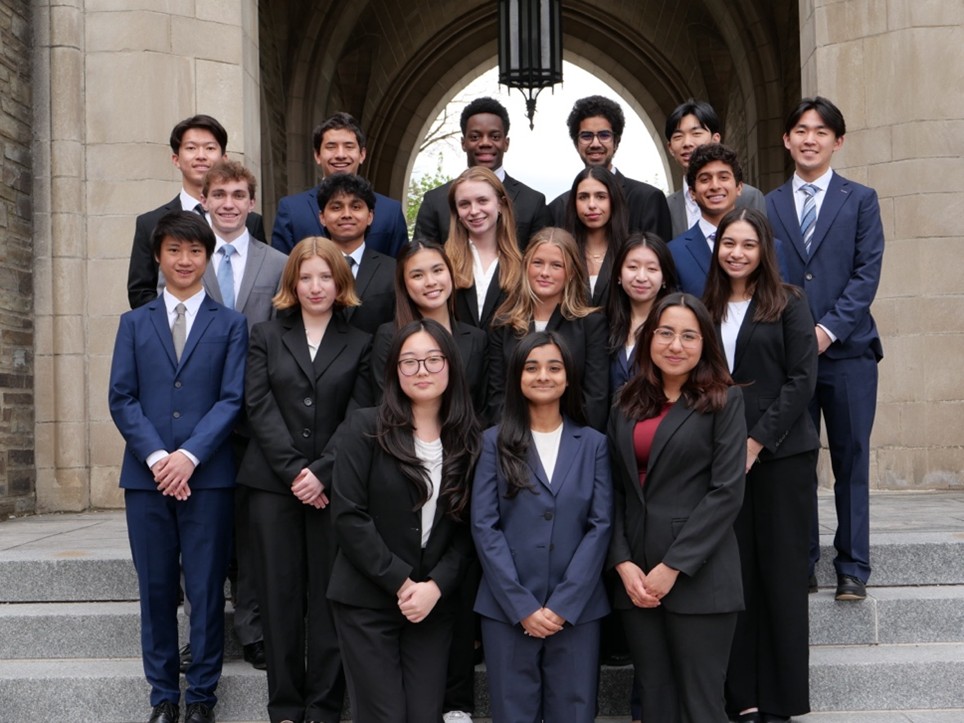
Ankita (Front and Center) with Cornell Classmates
Three years ago, I completed an environmental research trip to Chile and Argentina. Here, I researched the climate change impacts of lithium mining and the effects of it on the Indigenous communities in the Andes. Lithium is a resource that is used in many everyday items like batteries and electric vehicles. At the same time, lithium mining also contributes to water contamination in the Andes for the communities living nearby.
On the surface, people might be tempted to eliminate the mining practice altogether. However, lithium is a major growing export for both Chile and Argentina. Despite this, ignoring the environmental consequences of mining is not a solution either. This experience made me consider how financial decisions can influence the way businesses or even countries balance economic growth with environmental protection.
Creating a more sustainable future involves weighing which businesses receive the funding they need to operate and grow. Investors can prioritize profits or invest in companies whose environmental values align with their own. If investors consider both financial performance and environmental impact, they can create a more sustainable future while creating profit for themselves. This is where finance and sustainability begin to speak the same language.

Warren Hall, home of the Charles H. Dyson School of Applied Economics & Management at Cornell University. Courtesy photo
RISK VS. REWARD
When investing, profitability is often a major consideration. However, environmental factors can also affect a company’s financial performance. For example, data centers require large amounts of water for cooling its systems. With large dependence on water, operations can become more difficult if there is a shortage of water. Similarly, a business that overlooks pollution or environmental regulations may face financial consequences in the future.
Considering these risks alongside profitability can help investors and businesses make more informed decisions. Investors can also choose to support companies that demonstrate a commitment to positive impact like Patagonia, a well-known apparel company. Sustainability is not separate from a company’s financial future but can be an important part of understanding whether that company will succeed in the long run.
The connection between sustainability and finance is important because financial decisions affect more than the individual investors and impact investing has historically resulted in higher returns. Environmental awareness has become even more prevalent, and with that, there becomes a clearer connection between sustainability and finance.
As sustainable awareness increase, we can see the impact investing field growing each year. According to the Global Impact Investing Network, roughly 3,907 organizations managed $1.571-trillion in impact-investing assets worldwide in 2024. This accounted for a compound annual growth of 21% since 2019. This area demonstrates a strong connection between creating positive profits and impact. This does not mean that every sustainable business will be profitable or that every investment with an environmental mission will create meaningful change. However, it shows why both financial performance and environmental outcomes should be considered when evaluating a business.

Ankita Chakraborty
LESSONS THROUGH CORNELL
At Cornell University’s Dyson School, I joined the Impact Investing Club, an undergraduate organization that provides pro bono financial and market research to firms working to create positive social and environmental impact. Through the club, I have learned how financial tools can help businesses pursue both financial returns and meaningful change.
Through this club, I have begun to understand the the connection between impact and finance in practice through my work with a healthcare startup. The startup was seeking financial work support through financial statement creation as well as investor pitch materials. While this work was aimed towards helping the company create profits in their future, the product it offered facilitated positive social impact. Balancing profit and impact is possible.
As I continue my undergraduate education, I hope to learn more about the different ways I can bridge the gap between finance and sustainability since they are already intertwined. My experiences have shown me that environmental challenges often involve economic trade-offs and addressing them requires an understanding of both. With the right mindset, investors and businesses can make decisions that account for financial success while also considering their environmental impact.
Finance and sustainability may at first seem like two very different fields, but they are connected through forward thinking investors and hopes for a sustainable future. Learning to evaluate these decisions together can help create opportunities for businesses and investors while contributing to a more sustainable world.
Bio:
Ankita Chakraborty is a junior at Cornell University’s Dyson School, studying Applied Economics and Management with concentrations in Finance and Business Analytics. She serves as President of the Dyson Undergraduate Council, Co-President of Cornell’s Impact Investing Club, and a member of the Dyson Dean’s Student Advisory Council. She spent her freshman summer conducting research with Cornell’s Cañizares Center for Emerging Markets and her sophomore summer as a Fellow at JP Morgan, experiences that further shaped her interests in finance, leadership, and sustainability. Outside the classroom, she enjoys traveling, photography, and fencing. Click here to connect with Ankita on LinkedIn.
DON’T MISS: POETS&QUANTS’ BEST UNDERGRADUATE BUSINESS SCHOOLS OF 2026
© Copyright 2026 Poets&Quants. All rights reserved. This article may not be republished, rewritten or otherwise distributed without written permission. To reprint or license this article or any content from Poets&Quants, please submit your request HERE.


