





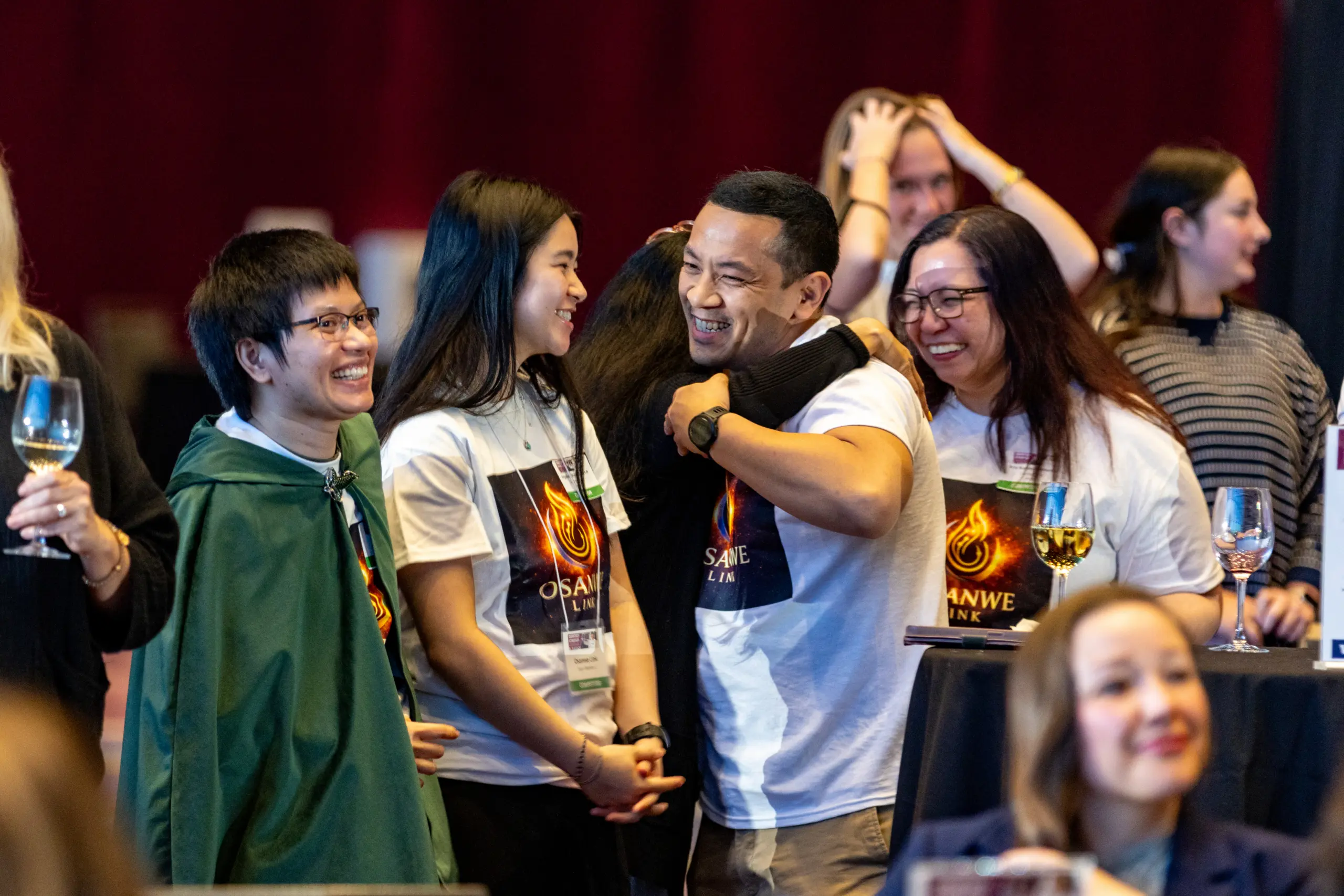
Students on the Osanwe Technologies team celebrate at Foster’s 2026 Dempsey Startup Competition. They developed technologies that enable non-verbal individuals to connect with the world.
The University of Washington’s Foster School of Business is expanding its two-year undergraduate business curriculum into a four-year experience for students entering in fall 2027.
The new timeline and redesigned curriculum will give incoming first-year students earlier access to business coursework, career preparation, and hands-on learning, including new courses exploring business’s role in society and introducing its different disciplines. Students will also have more time to explore courses and extracurriculars across the university and build relationships with classmates, faculty, and alumni.
“We have always felt like two years with our students was not quite enough to fully develop them as professionals and people,” Dean Frank Hodge tells Poets&Quants. “We’re trying to do both.”
Students will still complete UW’s general education requirements, and Foster will continue to admit transfers from UW and elsewhere.
GETTING AHEAD OF INTERNSHIP RECRUITING
One reason for the change is to introduce students to a recruiting cycle that is, for better or worse, starting earlier and earlier. By the time some students traditionally entered Foster, employers were already looking for their next interns, Hodge says.
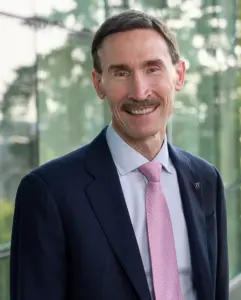
Frank Hodge, the Orin & Janet Smith Dean at the University of Washington Foster School of Business
Some industries are now recruiting student interns during their sophomore year. Two year programs, like Foster, were trying to help students compete for opportunities before knowing who many of their students would be.
“We don’t necessarily agree with that,” Hodge says. “We think that probably you’re better off getting some foundation before you go off and do an internship.”
But if employers are moving earlier, Foster needs to move with them. Bringing students into the school as freshmen will give faculty and career advisers more time to prepare them for those opportunities.
MORE TIME TO EXPLORE BUSINESS
The redesign began with Foster’s purpose of bettering humanity through business, Hodge says. School leaders asked whether the undergraduate program fully reflected that ambition and concluded it could do more.
There was also a competitive consideration. Hodge heard from parents whose children were admitted directly to business programs elsewhere but lacked that certainty at Foster. Some chose to leave Washington.
“That bothered me because we want to keep top talent from the state of Washington at the University of Washington,” he says.
Foster ranks No. 19 in Poets&Quants’ 2026 undergraduate business school ranking and tied for No. 20 in U.S. News & World Report’s 2027 ranking. Most of its top-20 peers already offer four-year programs, Hodge says.
The transition also gave faculty an opportunity to reconsider what students should learn and in what order. They reviewed coursework across disciplines, examining whether content could be combined and whether classes were developing the skills students would need after graduation.
New foundational courses will explore business’s role in society, including capitalism, how companies contribute to their communities, and what it means to lead an organization.
Another course will introduce accounting, finance, marketing, and supply chain before students choose a major. Faculty will teach the fundamentals, while professionals will explain what careers in those fields involve.
Foster realizes that an 18-year-old may arrive knowing they want to study business, “but they don’t understand what business is,” Hodge says.
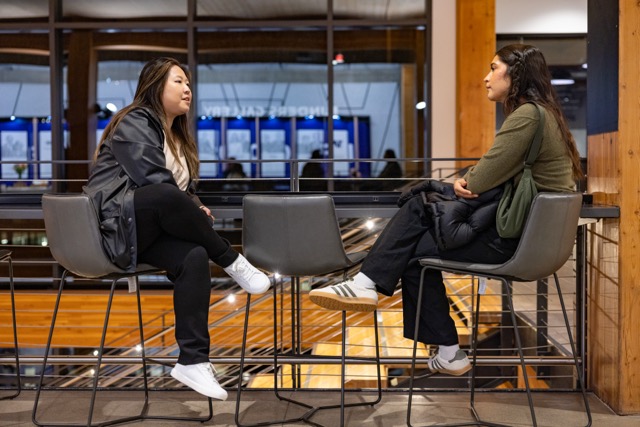
A Foster mentor and mentee exchange ideas at a fall networking event. The Foster Undergraduate Mentoring Program pairs undergraduate students with Foster alumni mentors for academic and early career development.
PUTTING BUSINESS KNOWLEDGE TO WORK
Foster’s redesigned curriculum will bookend students’ education with hands-on case experiences including a smaller company near the beginning and a larger business in the existing senior capstone.
Starting small should help students see how a business’s different functions fit together. Participating companies will contribute actual problems, and their representatives will judge students’ work.
“What seems quite clean in the classroom is not nearly as clean in the real world,” Hodge says.
He points to an existing project in Seattle’s International District, where student teams helped small and medium-sized businesses prepare for World Cup visitors. Students worked with businesses, many owned by minorities, on point-of-sale systems, supply chains, inventory management, and marketing.
The project predates the redesign but reflects Foster’s mission of bettering humanity through business, giving students practical experience while supporting the local community.
A TEMPORARY ENROLLMENT INCREASE
The expanded program also aims to get students involved earlier in opportunities such as Foster’s Dempsey Startup Competition, where teams develop and pitch ventures. In its Undergraduate Mentoring Program, incoming students match with alumni for academic and early career guidance. Earlier access gives students more time to test ideas, build relationships, and develop experience they can carry into internships and their first jobs.
Enrollment will temporarily increase during the transition. Foster plans to maintain its usual sophomore admissions while admitting more freshmen, preserving opportunities for current UW students who have been preparing to apply.
“We’re going to admit every single student that we would normally admit through the sophomore process, and we’re going to increase the number of students we admit as freshmen,” Hodge says.
Permanent growth is not the primary goal. After the transition, he expects enrollment to return to roughly 2,000 undergraduates.
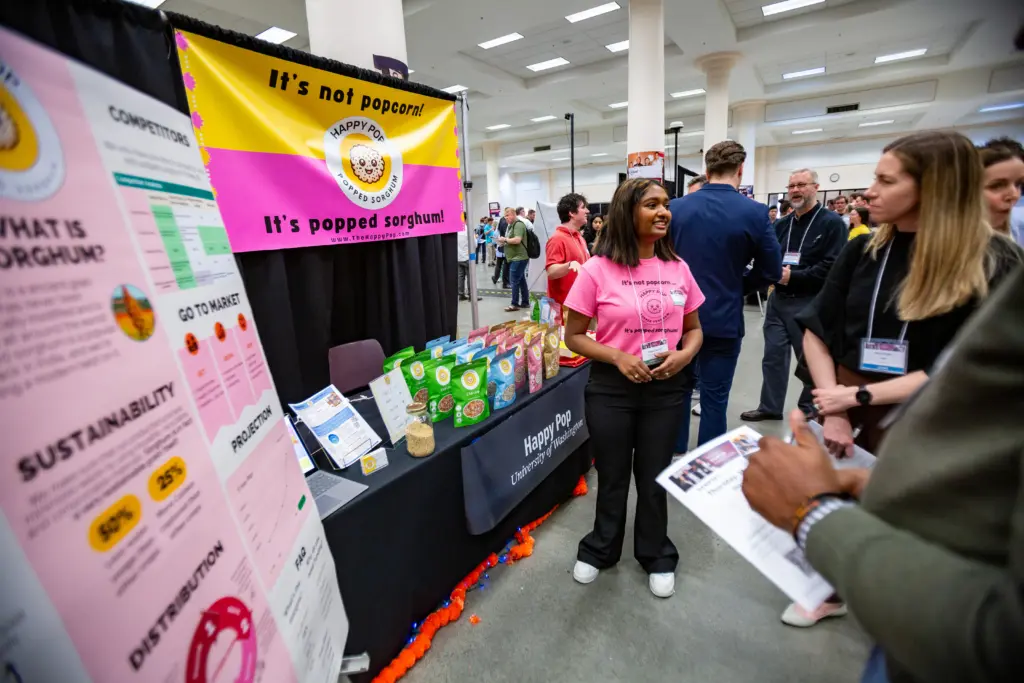
Students on the Happy Pop team demo product at Foster’s 2024 Dempsey Startup Competition. They developed a concept for a guilt-free snacking experience with handmade, Indian-inspired snacks.
PREPARING FOR AI AND A CAREER OF LEARNING
The redesign also responds to changing employer expectations. Foster’s goal is for every student to be AI ready, including knowing when to use the technology and when to work without it.
Students also need to recognize that the tools they learn as freshmen may change substantially before graduation. Foster is building flexibility into the curriculum by emphasizing emerging technologies rather than tying courses to a particular tool.
Hodge is skeptical that companies can eliminate entry-level jobs while maintaining a supply of experienced managers.
“We have to have a foundational base where we get fundamental skills to the younger generation so that they can become that experienced next manager level,” he says.
Some graduates may gain that experience at smaller companies rather than large corporations. Business schools also have a responsibility to provide opportunities through case competitions, entrepreneurship competitions, and other projects that students can draw on in job interviews.
For Hodge, the shift reflects a broader change in business education. When he began teaching accounting, the emphasis was on developing content experts who knew the answers. Today, with information readily available, students increasingly need to know how to ask useful questions and keep learning.
“You have to be continuously learning,” he says. “You have to say, ‘Those skills got me this first job, but I have to be learning to get the next job. And we want to be a part of that career journey and not just the four-year journey of the undergraduate program.”
DON’T MISS: STUDENT DEBT: THE CULPRIT DELAYING MAJOR LIFE MILESTONES FOR GRADUATES AND THE P&Q INTERVIEW: APPOINTED TO SECOND TERM, MICHIGAN ROSS’ SHARON F. MATUSIK ON PREPARING BUILDERS FOR THE AGE OF AI
© Copyright 2026 Poets&Quants. All rights reserved. This article may not be republished, rewritten or otherwise distributed without written permission. To reprint or license this article or any content from Poets&Quants, please submit your request HERE.


