

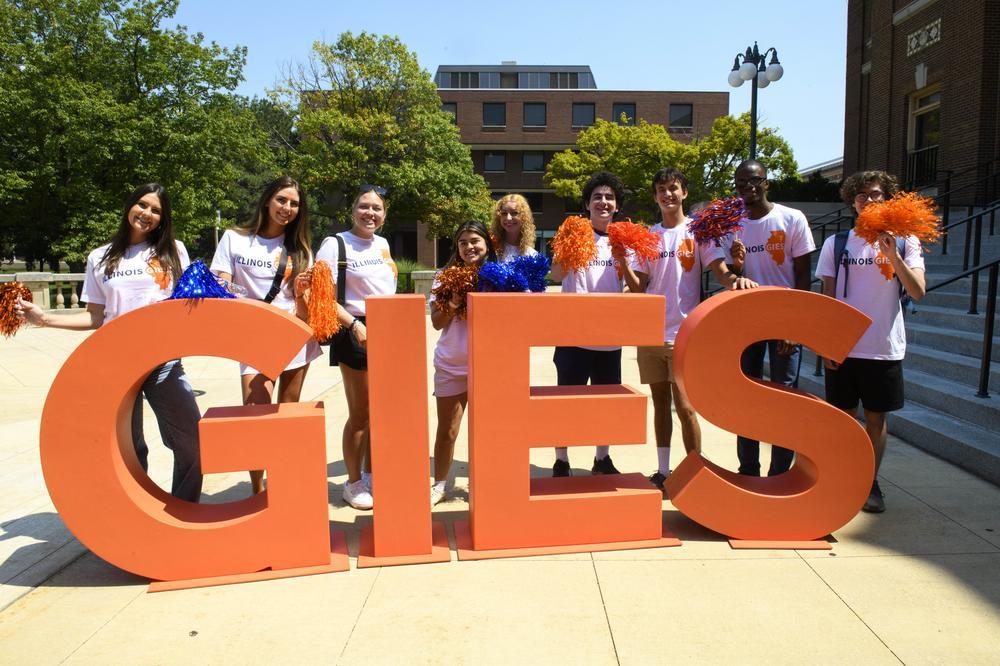
Gies College of Business students gather behind the school’s signature orange branding. For Class of 2026 graduates, career experts advise fewer mass applications and more targeted networking, alumni outreach, and in-person conversations. Courtesy photo
For business students graduating into the Class of 2026 job market, the AI-fueled spray-and-pray strategy may no longer cut it.
Employers are still hiring, but they are moving more carefully, making decisions later, and placing more weight on relationships, referrals, and in-person conversations, says Kristina Wright, senior director of the Office of Career and Professional Development at the Gies College of Business at the University of Illinois Urbana-Champaign.
“I would say it feels a little bit more cautious, but still active,” Wright says. “The advice that we give students is that they do need to be a little bit more strategic in their approach to the process.”
WANTED: AI NATIVES
The uncertainty 2026 grads face is driven by both economic caution and the still-developing impact of artificial intelligence on entry-level work. Some employers are delaying hiring decisions to see how their open positions will be impacted by AI and where the market is going.
Other companies are actively looking for graduates with strong AI skills to fill open jobs. For business students, that means the first job out of college may still carry a familiar title in consulting, finance, accounting, and marketing, but job descriptions are starting to change.

Kristina Wright
“I think the expectations right now for entry-level roles are actually higher because of AI,” Wright says. “I think they are looking for AI natives to be able to come in and use critical thinking and judgment.”
That’s particularly good news for 2026 graduates. Generally, they began college just as ChatGPT went public and unleashed the current AI wave. They’ve studied with AI, applied it to real-world business problems and group projects, and learned how to evaluate its output. At Gies and other top business schools, students would have learned how to use AI responsibly and while being able to explain when it adds value. That makes them particularly attractive to hiring managers grappling with whether and how to integrate AI into their own workflows.
CAREER RECRUITMENT STARTS EARLIER THAN EVER
At Gies, career preparation starts in the first semester, before business majors actually get into their business courses. Wright’s office works with students through professional development, career coaching, interviewing, job search strategy, and classroom-integrated career preparation. The goal is to make sure students are not just finding jobs, but learning how to navigate a market that is changing quickly.
For fields like accounting, consulting, and investment banking, employer recruitment pipelines can begin as early as freshman or sophomore year. That can be stressful for students who are still figuring out what they want to do.
“The job market career is going to change so fast. What will exist in five years that we don’t even know about today?” Wright says. “Our emphasis is really on competency development, so that there’s a lot of adaptability as roles change and as their interests change. We want them to have the right skills to be able to adapt to those new opportunities.”
Gies has also been embedding AI across the curriculum, which Wright says is helping prepare students for roles where AI fluency is increasingly expected.
Despite the more cautious environment, Gies continues to report strong undergraduate outcomes.
Among Gies accounting undergraduates in the Class of 2025, 96% found a job or continued education, with a median starting salary of $81,000. Wright says outcomes across Gies’ business majors have remained strong, with several programs reporting rates in the high 90s.
In Poets&Quants 2026 ranking of the Best Undergraduate Business Schools, Geis reported a 96.2% employment rate within three months of graduation for all business majors in the Class of 2024 and a 94.8% rate for the Class of 2025.
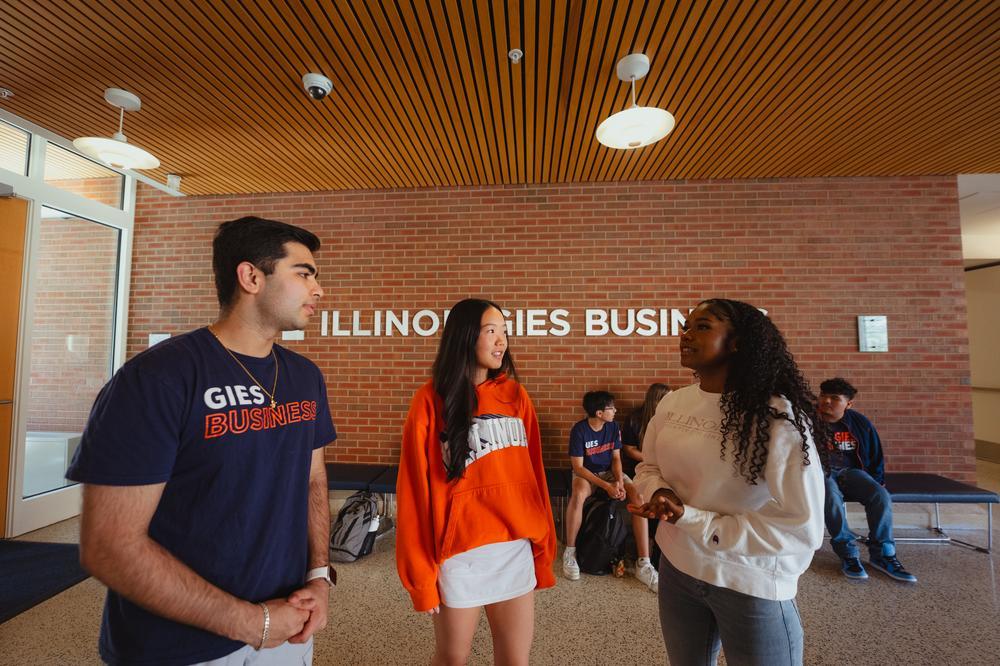
As AI makes it easier to polish resumes and cover letters, business students may stand out more through communication, critical thinking, teamwork, and the ability to explain their experiences clearly, says Kristina Wright, senior director of career and professional development at Gies College of Business. Courtesy photo
DOS & DON’TS: LESS MASS APPLYING, MORE HUMAN TOUCH
So, what is a 2026 graduate (or a 2027 or 2028 graduate for that matter) to do in a job market that no one really can predict? Wright offers a few dos and don’ts for standing out.
Don’t mass apply: The biggest mistake Wright sees is students applying to hundreds of jobs and assuming the sheer volume will improve their odds. It’s simply not a numbers game anymore. It’s safe to assume most job candidates are playing the same game with the same AI tools.
Mass applying is not a substitute for a focused search built around positions that match a student’s skills, interests, and experience, Wright says.
Don’t emphasize technical skills above all else: Students may be tempted to lead with their AI and technical skills. While they should definitely be apparent, Wright says employers increasingly assume that younger candidates have at least some familiarity with AI.
“What really helps them to stand out are those human skills,” Wright says.
Communication, teamwork, judgment, and critical thinking can separate one AI-literate candidate from another.
Do become a storyteller: For Wright, one of the most important skills in the job search is the ability to explain what a student has done and why it matters.
“We’re hearing consistently from our recruiters that experience is the No. 1 most important thing that they’re looking for on a resume or in an interview,” she says.
Students should be prepared to describe what they learned from an internship, class project, student organization, or leadership position; what impact they made; and how the experience prepared them for the job they are seeking.
Do seek out human connections: Wright suggests attending school-hosted networking events, joining student organizations with ties to employers or industries, and reaching out to alumni who may be able to offer advice or make introductions.
“Employers want the high-value in-person personal experiences with our students to really get to know them, so they can keep an eye out for that student through the application process,” Wright says. “What we find is that students who are willing to take that first step and to build those relationships are seeing results much faster than simply applying on a job board.”
She suggests starting with your own personal network first, then actively reaching out to alumni and other school networks.
For Wright, the renewed focus on human connection is actually one of the more encouraging developments in a new, uncertain job market.
“With AI being so heavy in the equation now, the fact that human skills are really rising to the top is really exciting,” she says.
“There’s never been a time that I know of that we’ve talked so much about the value of people, our relationships and our communication.”
DON’T MISS: AMERICANS ARE LEARNING TO COOK. THEY’RE ALSO LEARNING AI. GUESS WHICH ONE WINS AND AT AALTO, ROSS STUDENTS FIND FINNISH SAUNA CULTURE, PUB CRAWLS, AND A DIFFERENT PACE OF LIFE
© Copyright 2026 Poets & Quants. All rights reserved. This article may not be republished, rewritten or otherwise distributed without written permission. To reprint or license this article or any content from Poets & Quants, please submit your request HERE.


