



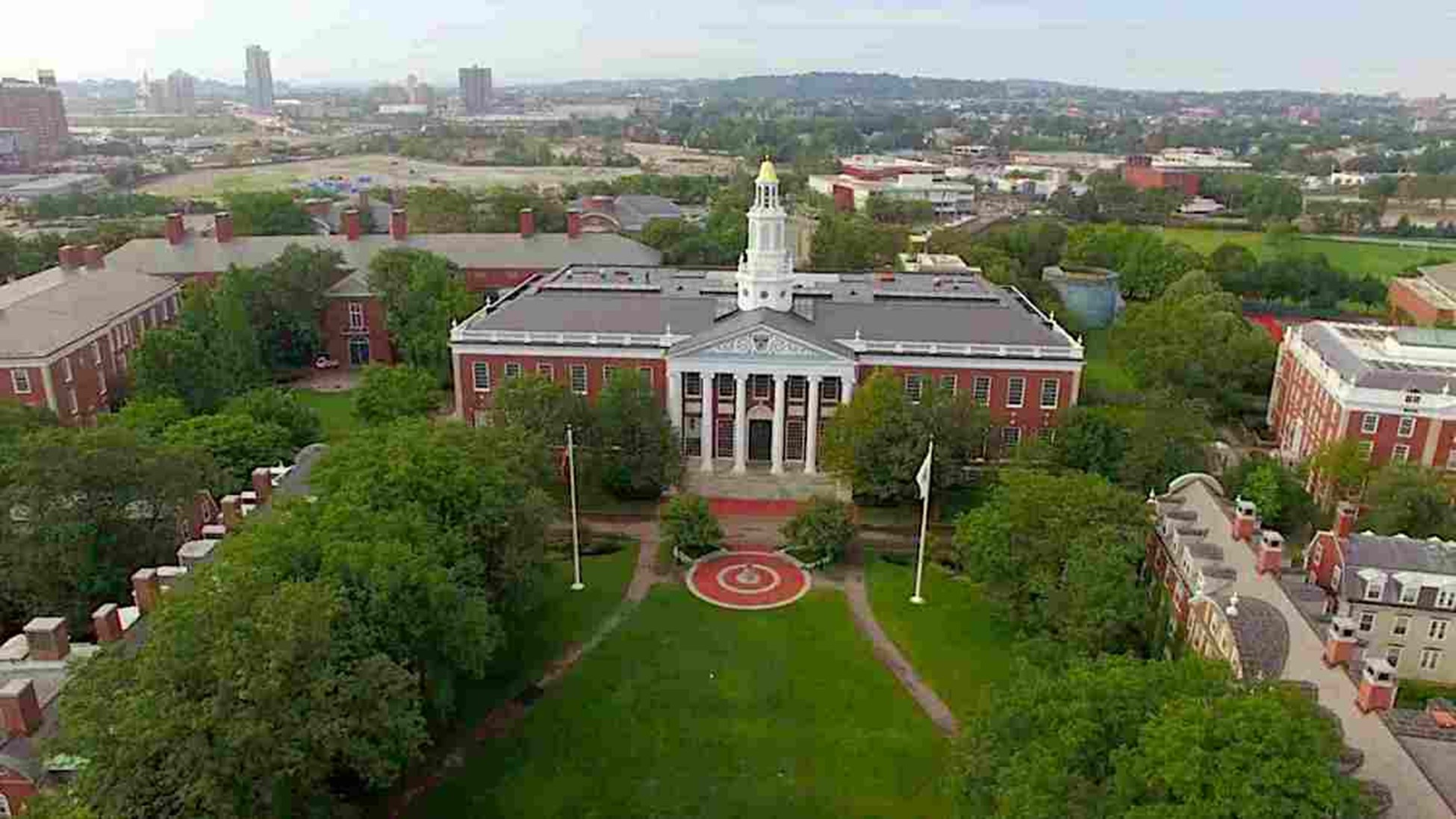
Harvard Business School
Schools can be evaluated according to a range of criteria. There is the quality of students they attract, often interpreted through test scores. There are post-graduation outcomes such as job placement or starting pay. Of course, there are student satisfaction surveys that measure everything from teaching quality to the experience in general.
Leadership development? That really doesn’t come up much – but it is so underrated. Let’s face it: leaders receive better opportunities, make greater impact, and earn more money. That translates to higher satisfaction, security, and status. Question is, which colleges and university provide the support that prepare graduates for leadership roles?
TOP SCHOOLS HOLD THEIR POSITIONS
That’s a tough question – and one that comes with a lagging indicator. After all, leadership roles are often attained a decade or more after graduation. Still, TIME magazine gives the old ‘college try’ in trying to answer this question. The result is the 4th annual “Best Colleges for Future Leaders”, which was released on November 19th. Covering 125 schools, the ranking eschews a deep dive into leadership development programming across the academic curriculum and extracurriculars. Instead, it focuses on outcomes: which school alumni are found in top roles across areas ranging from business to government.
Again, Harvard University holds the top spot with a perfect 100 index score. That lapped runner-up Stanford University, which posted a score that was 9.74 points lower than its Cambridge counterpart. That said, a year ago, the gap between Harvard and Stanford was 15.53 points, meaning ‘The Farm’ has gained quite a bit a momentum. From there, Harvard’s Cambridge neighbor, the Massachusetts Institute of Technology (MIT) rounded out the Top 3, pushing Yale University down a spot in the process. Columbia University again clung to the 5th spot.
Moving further down, the “Best Colleges for Future Leaders” ranking closely resembles the previous year. The University of Pennsylvania, the University of California at Berkeley, and New York University again held the 6th through 8th spots respectively (with Princeton University again finishing 10th). The biggest news? The University of Michigan and Georgetown University exchanged spots over the previous year, with the Wolverines inching up to 9th and the Hoyas slipping to 11th.
THE METHODOLOGY
The “Best Colleges for Future Leaders” ranking is rooted in a partnership between TIME and Statista, a market intelligence firm that connects over 50,000 sources and operates across over 170 industries and 200 countries. To formulate the ranking, Statista compiled a list of nearly 5,900 U.S.-based leaders, “including CEOs of the country’s largest public and private companies, leaders in politics and government, award-winning academics and scientists, and prominent figures in healthcare, media, sports, culture and philanthropy.” From there, Statista broke down these leaders’ education backgrounds and career paths. Along with incorporating sources like “company websites, university profiles, official biographies and professional networks, Statista also partnered with MixRank to deepen its research into the career histories of these figures.
To create a level playing field, Statista also divided leader count “by the logarithm of its student enrollment to calculate the Leadership Index.” To be included, colleges and universities also needed to meet certain thresholds according to the methodology.
“Colleges [were ranked] based on [leaders’] their educational backgrounds. To be eligible for inclusion in the ranking, a college had to be associated with at least five leaders in the dataset…125 highest-ranked colleges are included in the 2027 list.”
TOP SCHOOLS FOR LEADERSHIP CLUSTERED IN THE NORTHEAST
Overall, the rankings remained relatively stagnant. In the Top 20, eight schools held the same spot, while another 6 moved up or down one spot. Here, the biggest moves were made by the University of Virginia and UCLA, with each rising three spots (17th to 14th and 20th to 17th respectively). As the whole, the 2027 “Best Colleges for Future Leaders” ranking featured the same 20 universities and colleges as the 2026 ranking.
Beyond the Top 20, there was quite a bit of movement. Howard University and Tufts University both rose 11 spots (43rd to 34th to 54th and 43rd respectively). Boston University zipped up six spots to 25th, while Michigan State (40th to 32nd), Vanderbilt University (39th to 33rd), and the University of Georgia (47th to 41st) also achieved notable progress in leadership placement. However, some schools also lost ground. That starts with the University of North Carolina, which tumbled from 23rd to 35th. The University of Pittsburgh matched UNC’s feat, dropping from 32nd to 44th. Texas A&M also tripped up, going from 33rd to 39th.
This year, there were three schools that entered the Top 50: Tufts University, Syracuse University, and the University of Iowa. These school took the places of the University of Miami (FL), Miami University (OH), and the University of Hawai’i. In addition, you’ll find several big-name institutions outside the Top 50, including Wellesley College (60th), College of William & Mary (63rd), Georgia Tech (64th), University of Florida (65th), Brigham Young University (72nd), and Rice University (80th). In a surprise, the list doesn’t include any American service academy.
Regionally, the Northeast dominates the “Best Colleges for Future Leaders” ranking. Seven of the Top 10 schools are found in the Massachusetts, Connecticut New York, New Jersey, and Pennsylvania. Stretched out to the Top 20, California boasts four educational institutions, edging out New York with three. Outside the Top 20, the Northeast continues to lead the pack with another 9 schools ranked, followed by the Midwest with 8 schools. By the same token, private schools account for 8 schools in the Top 10 (and 16 in the Top 20). Among the remaining 30 schools in the Top 50, there are 17 public universities represented.

Stanford University
TIME INTRODUCES A BEST SCHOOLS FOR WOMEN LEADERS RANKING
According to TIME, the ranking added nearly 1,100 leaders for inclusion over the previous year. That may be one reason why the index scores improved for every school in the Top 50. In fact, there were 13 schools which saw their index score improve by two points or more – though all were found in the Top 20. That said, the index scores do raise questions. While there were only two ties among the Top 50 schools, the scores were often bunched together. For example, just .11 of a point separates the schools ranked 34th through 40th. At the same time, there is one point or less between the schools ranked from 11th to 19th. Such clusters often indicate a methodology that doesn’t clearly demarcate schools from each other.
That’s just one of the issues dogging the “Best Colleges for Future Leaders” ranking. There is no data, just a one-dimensional index score. As a result, readers cannot conduct side-by-side comparisons of educational institutions across the data points that matter to them. Call it the Wizard of Oz ranking, where readers can’t peek behind the curtain (and may be dismayed by what they find). The lack of data also prohibits readers for identifying why particular schools are rising or falling. More than that, it clumps undergraduate and graduate education together – not to mention all of each school’s disciplines. As a result, it is near impossible to discern where exactly these colleges and universities excel.
That’s not to say there isn’t real value here. The rankings can, to an extent, potentially tip readers off to which schools distance themselves from counterparts in areas like alumni engagement, teaching prowess, resource allocation, and company connections. While the ranking also excludes international institutions, it does take special interest in women.
This year, TIME rolled out a “Best Colleges for Future Women Leaders”, noting that women now account for 45% of the leaders included in the data. Like the overall ranking, Harvard and Stanford run 1st and 2nd, with Yale returning to the #3 spot. Overall, among Top 20 schools, 19 of 20 institutions overlap between the Future Women Leaders and the overall list. The anomaly was the University of Wisconsin. It placed 20th among women, up from being 24th overall. UW also replaced 15th-ranked University of Chicago, which did not make the cut on the Future Women Leaders list.
To see Time’s Top 50 Colleges and Universities for Future Leaders and the Top 20 Schools for Future Women Leaders, go to the next page.
© Copyright 2026 Poets&Quants. All rights reserved. This article may not be republished, rewritten or otherwise distributed without written permission. To reprint or license this article or any content from Poets&Quants, please submit your request HERE.


