




Customers or employees? Who has greater value?
Talk about a chicken-or-egg debate!
Customers pay the bills. Many aren’t shy about telling companies what they want and where they could improve, either. Let’s face it: A customer’s word carries far more weight than any pitch deck.
Employees? They are the heart of any organization – the true believers who personify the brand and execute the vision. They ingrain consistency and build relationships. When companies begin to falter, you can skip the balance sheet for answers; the source can often be traced to a loss of faith among the rank-and-file.
Those doubts often stem leadership. Regardless of level, there are naturally gaps between words and behavior and expectations and rewards, where ego overshadows service and contentment trumps initiative. In the end, it is good leadership that settles the debate between customer and employee: acting as the bridge by serving as diplomat, evangelist, visionary, and tactician all wrapped into one.
DISNEY & NASA SHOOT UP THE TIME RANKING
That begs the question: How do companies develop such leaders? TIME Magazine leaves the “how” out of the equation, whether that is measured by talent scouting, corporate training, or ongoing mentoring. Instead, in its annual “Best Companies for Future Leaders” ranking, released on November 19th, TIME focuses on measuring which companies produce the top leaders.
Like previous years, McKinsey & Company again holds the top spot, posting a perfect 100 index score in the process. IBM continued to be the runner-up to McKinsey, whose 95.32 index edged out Alphabet at 95.30. Goldman Sachs and Mass General, a Massachusetts healthcare system, rounded out the Top 5.
Notably, Alphabet climbed 6 spots, which was accompanied by an 8.6-point improvement over the previous year. That pales in comparison to the Walt Company Disney, which jumped from 23rd to 6th, coupled with a 10.5-point improvement. Microsoft and NASA also entered the Top 10 in the 2027 ranking, with the latter improving by 10 spots and 6.13 index points. In contrast, PwC and Deloitte dropped into the 9th and 10th spots respectively, with the former ranking 4th just a year ago.
What’s behind the 2027 “Best Companies for Future Leaders” ranking? Now in its fourth year, the ranking is the product of a partnership between TIME and Statista, a market intelligence firm that connects over 50,000 sources and operates across over 170 industries and 200 countries. In this ranking, TIME and Statista “highlight the career stepping stones that shaped over 5,900 influential U.S.-based leaders from business, government, academia and society.” They add that each ranking adds younger leaders to the list each year, with the number of leaders evaluated increasing by 1,100 in this newest ranking. As a whole, the list features 175 American-based companies.
In the past, TIME has noted that the list is an attempt to “capture the full scope of influence” of companies in developing leaders across various private organizations and public sector institutions. As part of parsing the data, TIME included resumes and media stories, with an emphasis on career progression and internal achievements, while eschewing feats like board memberships and honorary degrees that were generally derived from their existing status.
THE McKINSEY DIFFERENCE
For over a century, McKinsey & Company has been known as a leadership factory. Their alumni roster is impressive, featuring luminaries like Alphabet CEO Sundar Pichai and Citigroup CEO Jane Fraser – not to mention the current CEOs of Visa, Lockheed Martin, Allianz, and Novartis. In the public sector, you’ll also find former McKinsey consultants like U.S. Senators Tom Cotton and Dave McCormick, not to mention influential former officials like Susan Rice and Pete Buttigieg.
One reason is the variety. Every two or three months, McKinsey consultant teams are supporting a new client in a different industry – often tackling a complex issues plaguing organizations worldwide. In the process, McKinseyites are exposed to how various functions – be it strategy, sales, operations, or finance – are deeply interconnected. Call these engagements living case studies, where McKinsey consultants dig into the root causes by learning how to ask the right questions to the right people in the right contexts. As a result, many McKinsey executive alumni have gotten their hands dirty in some of the biggest business issues of the century, such as the advent of eCommerce or supply chain disruption during COVID.
That variety prepares McKinsey to handle any problem – from any angle – once they take an off-ramp to another company. “No two projects are the same and no two clients are the same,” says Hob Du, a 2025 McKinsey hire and Stanford GSB alum. “Even when the topics are similar, every study has its own unique set of challenges; it just never gets old. Every Friday, on my way back from the client site, I sit back and reflect on the week, and I’m consistently amazed at how far I’ve advanced from Monday: new skills and new insights.”
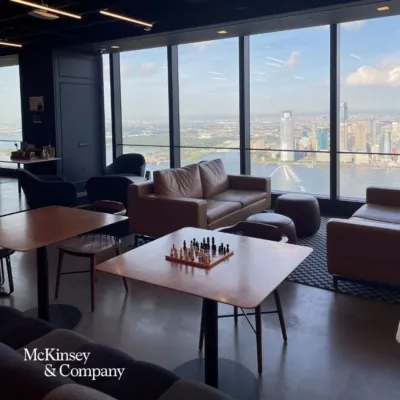
McKinsey’s New York office in 3 World Trade Center overlooks the Hudson River
ALPHABET: THE AI EXECUTIVE FEEDER
That’s not to say every consulting firm produces leaders at the same quality as McKinsey, which leans heavily on an apprenticeship culture with high expectations and ongoing training. The Boston Consulting Group, a member of the hallowed MBB, placed 19th in the “Best Companies for Future Leaders” ranking – nearly 17 index points under McKinsey & Company. By the same token, Bain & Company skirts the bottom of TIME’s Top 50 at 48th. That said, counting Accenture, Deloitte, and PwC, six consulting firms crack the Top 20 in this year’s ranking, beating out Banking (4) and Technology (3).
At Alphabet, leaders are tackling the proverbial ‘big hairy audacious goals’ such as open AI and autonomous. Even more, the company relies on a research-driven model for identifying and developing leadership talent, emphasizing areas like interpersonal skills, coaching prowess, ongoing learning, and a results-driven mindset as much as technical skills. Along the way, TIME points out, Alphabet has seeded many of the top AI firms with its alumni.
“Alphabet is one of the most common career stops among TIME honorees. They are especially notable in shaping the buildout of different applications of AI, including Moonshot AI co-founder Yang Zhilin, Ricursive Intelligence co-founders Azalia Mirhoseini and Anna Goldie, Kera Health Platforms founder Moustapha Cissé, and OpenAI’s lead of Health AI Karan Singhal.”
RISERS & FALLERS
This year’s biggest debut came courtesy of SkyDance – the merger between Paramount and Warner Bros Discovery, which entered the TIME ranking at 12th. TIME lists SkyDance as a firm to watch for leadership rankings due to its impressive reach. “The merger is set to make SkyDance one of the biggest players in entertainment in the coming years, putting channels including HBO, Showtime, CBS, MTV, Comedy Central, Cartoon Network, Nickelodeon, TNT, TBS and CNN under one umbrella.”
WPP, a communications and tech firm, also joined the festivities at 30th. After a year absence, Amazon returned to the Top 50 at 32nd, with Comcast, Lockheed Martin, News Corp, General Motors, Howard Hughes Medical Institute, and Starbucks joining the list as well. By the same token, several firms tumbled out of the Top 50, led by RTX (31st), Cigna (32nd), and Motorola (37th).
Inside TIME’s Top 50, several firms also made big moves in the 2027 ranking. That was particularly true in the Tech sector, where Meta leaped from 40th to 20th, with Apple (49th to 25th) and Oracle (38th to 26th) following suit. That said, Dell Technology broke the sector’s hot streak, dipping from 35th to 47th, while Accenture (6th to 14th), KPMG (12th to 22nd), and Booz Allen Hamilton (22nd to 39th) all lost ground compared to the previous year.
At the same time, several household names missed the Top 50 cut in TIME’s “Best Companies for Future Leaders.” At the 72nd through 74th band, for example, you’ll find heavy-hitters T-Mobile, Salesforce, and Cisco Systems (in that order). More than that, health-related firms seemingly struggle to produce leaders, as evidenced by the rankings of Cigna (52nd), HCA Healthcare (58th), United Health Group (68th), CVS Health (78th), and Humana (85th). The same could be said for energy giants like Conoco Phillips (79th), Chevron (110th) and Shell (116th). And the biggest surprise? Nike finished just 167th overall, eighth from the bottom.
TIME INTRODUCES A RANKING FOR WOMEN
Geographically, New York dominates the top half of TIME’s Leadership ranking. 13 of the 25 highest-ranked companies are based in the state, with California (4), Massachusetts (2), and North Carolina (2) also boasting more than one firm. In the bottom half of the Top 50, there were four representatives from Texas, with Maryland, New York, and California tying with 3. In a surprise, Illinois was home to just one Top 50 firm. That’s one better than Florida, which had no home-grown firms represented on the list.
In a notable addition, TIME also released a second ranking, which covered the “Best Future Companies for Future Women Leaders.” IBM, which placed 2nd overall, topped this list. NASA and Walt Disney were the runners-up, with McKinsey finishing 8th here. In a testament to their leadership chops, every Top 10 company in the overall ranking placed in the Top 20 for women. The only eye-opener? Procter & Gamble, ranked 11th overall, didn’t make TIME’s women’s list.
In total, the TIME ranking offers valuable information to business graduates. For one, it shows which firms – traditionally – prepare employees best for leadership role – both inside and outside the firm. Equally important, it reflects the regions where ambitious graduates should head to best fulfill their leadership potential. That said, the ranking contains several flaws. For one, the list ignores non-American firms, with notable omissions including Saudi Aramco, Toyota, and Siemens. Even more, there is no underlying data available to help readers compare firms in areas that matter most to them. Instead, there is a simple index score – one that is no based on any specific methodology. Without this transparency, the “Best Companies for Leadership Leaders” must be treated more as a curiosity than an authoritative source.
To see Time’s Top 50 Companies for Future Leaders and the Top 50 Companies for Future Women Leaders, go to the next page.
© Copyright 2026 Poets&Quants. All rights reserved. This article may not be republished, rewritten or otherwise distributed without written permission. To reprint or license this article or any content from Poets&Quants, please submit your request HERE.


