

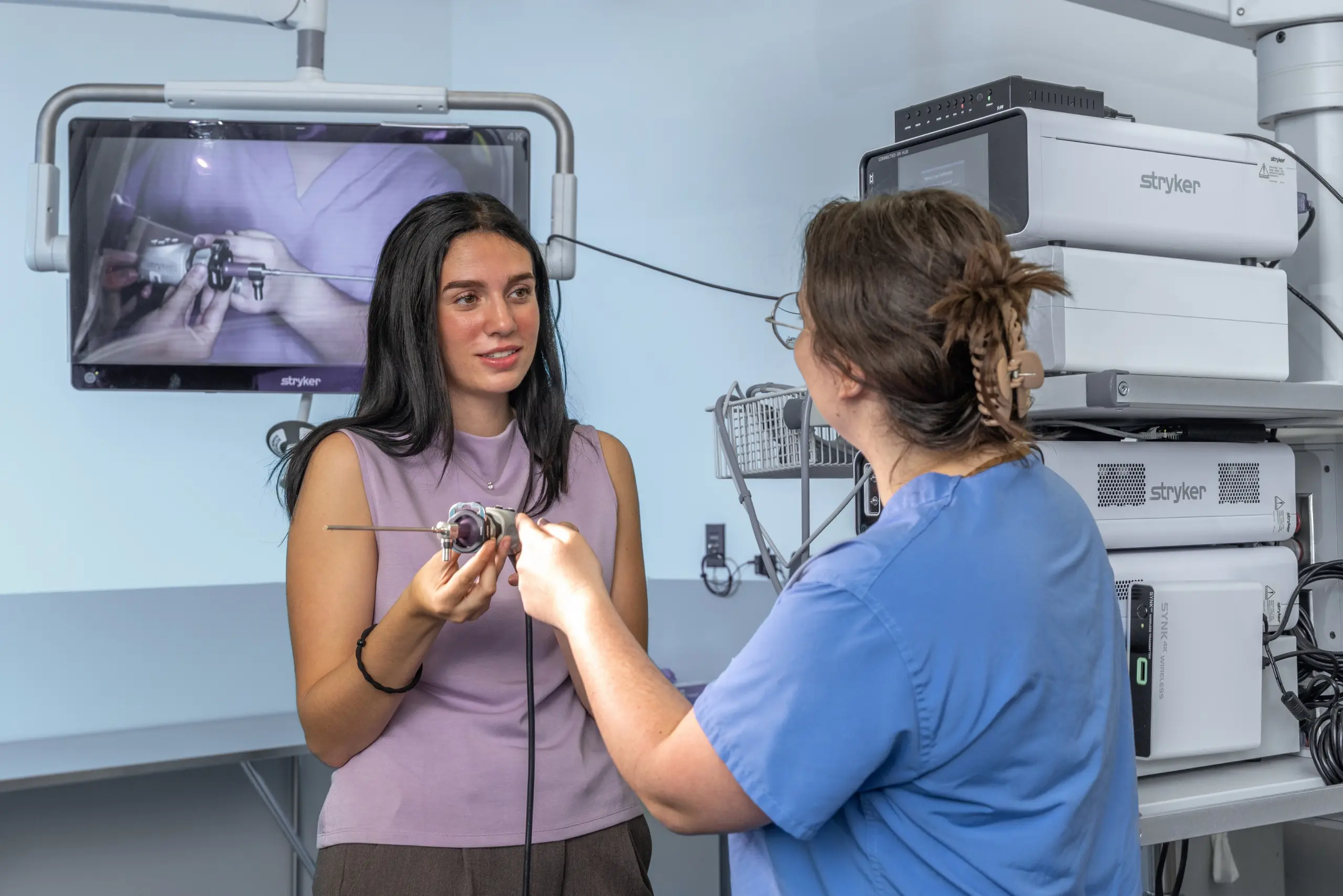
A Farmer School of Business student gets hands-on experience with surgical equipment through the school’s healthcare sales certificate, supported by Stryker. The program gives students a close look at the clinical environments and procedures they may encounter when working with orthopedic surgeons.
Business schools have long measured student success through grades, internships, job placement rates and starting salaries. Jenny Darroch thinks that framework stops too soon.
“I think business schools are really good at measuring students while they’re with us. We’re good at measuring students when they graduate,” says Darroch, dean of Miami University’s Farmer School of Business. “But what we all need to be better at is measuring and understanding what happens to them once they leave.”
At Farmer, Darroch is pushing a broader idea of career preparation, one designed not simply to land students a first job but to prepare them for careers that may stretch across industries, roles and technologies that barely exist today.
The distinction is to treat career development as an ecosystem rather than an office. That means starting with professional identity early and often in a student’s undergraduate experience and surrounding students with employers, alumni, experiential projects, industry credentials, student organizations and career treks.
Q&A WTIH JENNY DARROCH
The push comes as artificial intelligence is forcing business schools to rethink what, exactly, they offer students when knowledge itself is becoming cheaper and easier to access.
“As knowledge becomes more abundant and AI becomes more accessible, the competitive advantage of business schools is not what students know, but what they become,” Darroch says.
For Farmer, that means putting more emphasis on experiences that build judgment, leadership, professional networks and the ability to create value—not only at graduation, but throughout a career.
In the Q&A below, Darroch talks about what Farmer’s career ecosystem looks like in practice, why employers and alumni are becoming more deeply embedded in the student experience, and why she believes business schools need to start thinking well beyond a graduate’s first job.
Let’s start with the career ecosystem that you’re trying to build at Farmer.
The way we see the career ecosystem is as a distinct, connected group of entities, not an office. People go to a career office, but we see the career ecosystem as a connection of curriculum, co-curricular activities, employers, alumni, technology, experiential learning, career coaching, and student organizations, all connected together.
What we’re trying to do with our students is get them to see more than just the career office, more than just a program—that they’re going into one intentional, interconnected system.
If you think about what we do as business schools in general, and we’re certainly great at this ourselves, we have very engaged alumni, we have very engaged employers, we have AI, of course, enabling a lot of the work they do, and we’ve got a good professional network in place. We’re trying to get students to participate in the career process early and often so that they can develop a network before they’ve even graduated college.
You previously told Poets&Quants that you want to make Farmer the nation’s most connected and career-focused undergraduate business school. What led you to this ambition?
That’s a great question. I think business schools have always done a great job looking at career outcomes, and we tend to measure ourselves based on the first job someone gets upon graduation. Our rankings do that for us.
But when I think about AI and the world that we’re finding ourselves moving into right now, my view is that AI is giving access to knowledge and making knowledge more accessible. But the competitive advantage for business schools is the people that we develop. I see people development now as being at the heart of what we do, and career outcomes are more of a manifestation. They’re an indication that we’re doing well.
When I look at our position now, of course we prepare people for their first job. But how do we develop people who can have a lifetime of purpose, a lifetime of meaningful career? How do we move people beyond the first job into the second, third, fourth, and fifth jobs? That’s what we’re starting to pay a lot more attention to.
How do you see this in terms of the student experience? Walk me through what that looks like.
When I think about where we are as higher education in general, I think a lot of the way we measure our progress through the standards with AACSB focuses too much on curriculum.
We would argue that a lot of the richness of the experience actually comes in co-curricular activities. We’ve got 60 student organizations and clubs, and they would operate underground, sort of below the radar.

Miami Farmer Dean Jenny Darroch
I realized what they were doing and just how great they are: the speakers they would bring in, the case competitions they would host, the internships they promote, and the networking that led to jobs that they would facilitate. I thought, this needs to be part of the fabric of the school—not to micromanage what they do, just to bring them up a little bit.
So we’ve spent a lot of time with our student organizations, getting them to write their goals for the year, tell us what they’re doing, write a report on what they’ve achieved, and try to make them feel part of the fabric of who we are.
I’m using that as one example, but there are many other ways students gain experience—from case competitions and leadership roles in student organizations, where they can practice leadership, to career treks to Chicago to explore consulting or investment banking, or to Columbus, which is a major real estate market for us.
My point is that, of course, what happens in the classroom is really, really important, and we’re not diminishing that. But what we want our students to do is have a ton of other rich experiences that sit outside of that. When they present their résumé to an employer, we’re moving beyond what you’ve done to what you could do. How could you add value to an employer?
If I take that comment and expand upon it a little bit more, we’re over-indexing experiential learning now, and we think we need to do that because of AI. AI is giving answers. We all know that. But how do the students end up with an understanding of context, of the application of the functional knowledge they’re learning, and of the problems they’re trying to solve for employers?
If these clubs and experiential learning opportunities were already offered, is there more of a requirement behind them now? Are you looking to get more students involved?
I don’t think it’s for everybody. We do have over 5,000 students, but I think that would be one example where we’ve simply raised them up, provided resources, and tried to partner with them.
I think the other thing we’re thinking about is much more interconnection with industry. We’re bringing industry partners up the value chain much earlier so they can work with students and get them ready for the world of work they need to enter.
We’re doing a lot more with employers bringing in projects and working directly with students. Of course, faculty are involved too. But how do we elevate that even more so that we can move past launching careers to accelerating careers? That’s how we think about it here at the Farmer School.
There are plenty of data points, but I think the one we’re most proud of more recently is the LinkedIn rankings. We are No. 5 among public universities in that ranking, and that speaks to exactly what we already do well. It speaks to internships, network, career progression, and functional knowledge as well.
Can you tell me a little bit about the timeline for this? Where are you in terms of visioning and implementation? When did this start, and is there a formal strategy behind it?
Was there an inflection point? I think, for us, for the longest time—and this predates me—we’ve had a tagline that we graduate beyond-ready leaders who add value to any organization from day one. So that’s part of our DNA.
There’s not really an inflection point in that sense. It’s always been who we are, and I say that because we’re unashamedly more of an undergraduate-focused institution. We can devote our energy, time, and resources into launching careers, and that’s part of our DNA.
I think where I’ve become more energetic and focused about it is with AI. The inflection point that AI has caused has really made me reevaluate what we do and how we resource what we do.
It comes back to the point I made before: The competitive advantage for business schools, in my opinion, can no longer be measured by what students know. It can be measured by what they can do, how they lead, and the value they create.
So I spend a lot of time thinking about this rapid inflection point that’s been put upon us.
For example, we’ve got more than 5,000 students. I’ve got a product that I’m experimenting with called My Future Self. It’s one that students of ours who recently graduated have launched, and they’ve already got 3,000 subscribers.
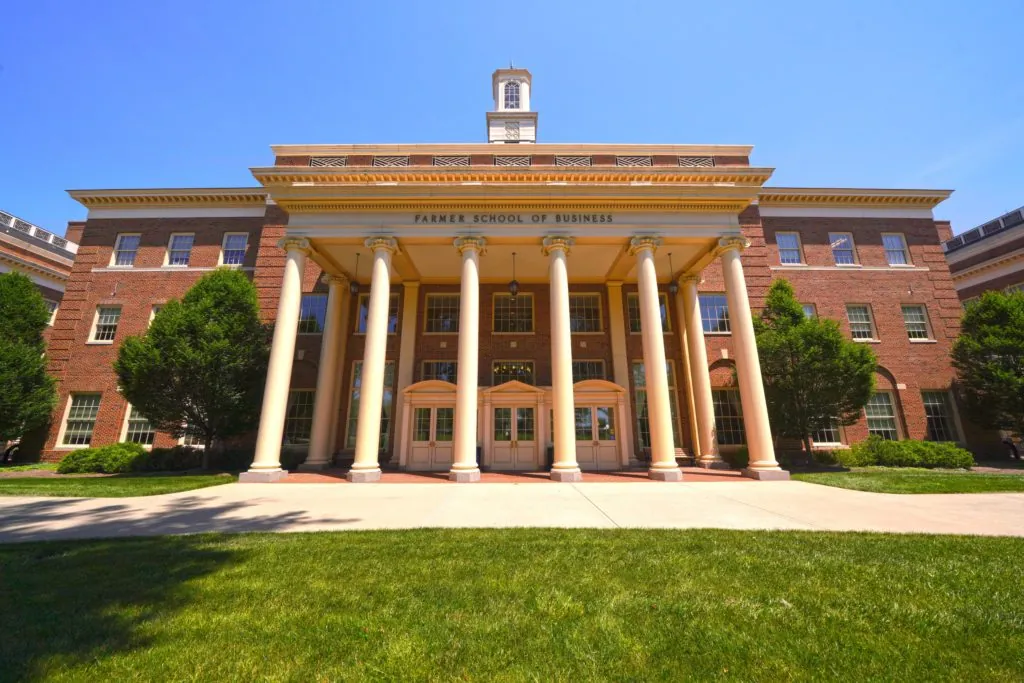
Miami University’s Farmer School of Business in Oxford, Ohio, is planning a new campus extension designed not simply to add classroom space, but to create more opportunities for interaction among students, faculty, alumni and employers—what Dean Jenny Darroch calls “more collisions” across the school’s career ecosystem.
My Future Self was created by Farmer alumni?
We have a good entrepreneurship culture here, and we have a Side Hustle Club. The students were in the Side Hustle Club, and they developed this. It was a really interesting product.
It started because they were worried about mental health, and we all worry about mental health with this particular age group. You wake up in the morning, go on the app, and it asks, “How do you feel?” If you feel anxious, do these three things. If you feel lonely, do these three things.
I said to them, “Look, this is great, and I love what you’re doing.” But what I could see was an end-to-end product that supports our students, not just with mental health, but helps them figure out who they are and know their why on the way in. It could help them align with a major they might be interested in, because we believe early and often is really important for our students, and then help guide them through the four years.
It could talk about the curricular and co-curricular experiences they need to have. We’ve also got someone who’s been doing some work on a product I’ve been looking for for years, but AI now enables it. It can start trawling through job descriptions and job postings, reverse-engineer them back to curriculum, and tell me where my gaps are. Equally, it can take a student’s CV and predict what jobs they should be going for.
That product already exists within our repertoire, but My Future Self is something that can now tie everything together. We’re super excited by it, and I think it could be a game changer for how we practice higher education in our business. I really do.
When you talk about an ecosystem, that clearly includes businesses, alumni, and others outside of Farmer. Are there any new ways you’re reaching out to them or asking them to get involved? What is your ask for those outside partners?
It’s really just to bring business in. We want to make sure that we bring business into the classroom and that we become a place where collisions happen—where there are more collisions between industry and students.
We already have an environment for that, but we’re also about to build a new building that will provide more space to facilitate it. We’re about to start working on a campus extension. We’ve just received $23.7 million in state money for that building.
We’ve just hired an architect, and we’re at the ideation stage. It will be open in three years. But we’re not going to build more classrooms. We’re building more collisions.
That’s what we’re talking about. We see the future of business school education as having industry partners become more prevalent and intertwined with everything we do here from a curriculum point of view.
Is there something special about the economic or regional ecosystem you’re working within for your students?
One of our challenges—and to be clear, I came from Los Angeles and before that New Zealand—is that Los Angeles is not Oxford.
We’re in the middle of southwest Ohio. We’re an hour from Dayton, an hour from Cincinnati, and about five hours from Chicago by road. That’s an interesting place for us to be.
What that means is we have alumni who come and visit and spend time here. They won’t just pop in to do a talk. When we bring in an alum, it’ll be: Can I present to a class? Can I mentor some students? Can I speak to the student club? Can I talk to the faculty member about what’s going on in practice? Can I support a project? They’re here for a period of time, so that’s brilliant.
The other thing I had not fully appreciated when I joined in 2020 was that there’s a type of student who comes to Miami, who comes to Oxford, Ohio, who is a great team member.
We’re graduating leaders who people want on their team. There’s this Oxford bubble. They come here, they learn together, they live together, they grow up together, and I think that’s why we end up well ranked by LinkedIn, because they’re just great networkers.
By the time they leave, in the first year we require students to build a LinkedIn page if they haven’t got one already. I think the assignment requires them to have 250 new people in their LinkedIn network before they finish that class.
Our alumni are just willing to give back. They’re incredible alumni. When we talk about the ecosystem, it’s not hard for us to enable that because we’ve already got it. We’re just amplifying it by putting more structure around it.
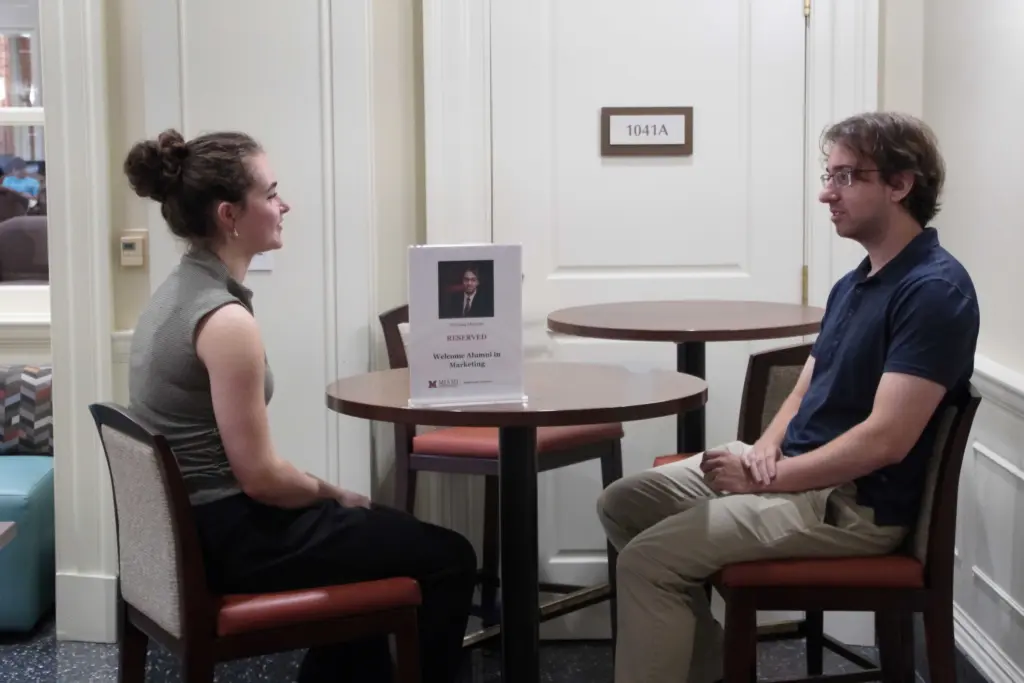
A Farmer School of Business student connects with an employer as part of the school’s broader career ecosystem, which brings industry partners directly into the student experience through networking, mentoring, projects and recruiting.
Business schools are always talking about career services. What is going to be different about Farmer’s approach compared with another peer business school?
For me, it’s about careers becoming more than the office. It’s part of what students live. They come here because they believe they’re going to have a more accelerated career path, and they come to us because they believe we develop them not just for their first job, but for a lifetime of career success.
I think what’s different for us is that we have a focus on undergraduate education. We do have some graduate programs, but by numbers, we are largely undergraduate, and we’re really, really good at launching careers.
We also have the view that the career office is one part of it, but so too are our alumni and our employers.
When you think of Porter’s value chain language, the tasks that many other providers used to do have been pushed back up to consumers. Take airline travel. We no longer go through the travel agent; We have to do everything ourselves. We’re having to deliver a lot more and co-create that value ourselves.
I think the same thing has happened with employers. There was a time when we would simply present a slate of students to the employer, and our grades would help them rank-order the quality. But now I see employers being pushed up the value chain to co-create value for the students together.
That’s what I see playing out right now, and that’s what we do here at Farmer. We bring our employers up into the value chain with us to co-create value for our students, so they can hit the job market ready and able to add value from day one.
I also think what’s really interesting, when you think about the future of education, is that there’s a lot of discussion around ROI. There’s discussion around maybe having more three-year degrees. You see little glimmers of that coming through. Good or bad, I’m not casting judgment.
But I think there’s a flip side to that, which is that students aren’t always ready to launch their careers after two or three years.
At the Farmer School, we transfer in a lot of high school credits, like many other prestigious schools do. But the students still stay here for four years. I think those who do end up with a robust portfolio where they can show an employer how they can add value and how they can make an impact.
In your conversations with employers, and from seeing where your students have been going over the last year or so, what kinds of changes have you seen in the market or in the types of jobs available?
We went from No. 14 to No. 4 for career outcomes in the Poets&Quants rankings this year, and we were massively impressed with that because, to your question, there are two things we hear in the hiring cycle: number one, economic uncertainty, and number two, AI replacing entry-level jobs.
Economic uncertainty is real. What that has done is create pauses in start dates. We didn’t see that many offers being rescinded, but we did see some pauses and delays to start dates. The power is with employers right now, and salaries just aren’t going up.
We’ve held our own with placements and internships, but salaries have been quite flat. Given inflation, that’s a slight problem for people writ large.
The other thing, of course, is AI. I think we’re moving quite quickly with respect to how we’re integrating AI into our curriculum and, in general, how we address it from a pedagogy point of view, but also how we embrace it for students.
For example, I took nearly 20 faculty and staff to San Francisco in June, and we spent a week there. We visited companies from Google to OpenAI down to small startups, just to be exposed to what was happening in Silicon Valley.
We’ve got a teaching grant out there right now for $100,000, with $5,000 grants for faculty who want to be more innovative and integrate AI, however defined.
The issue of tokens is becoming a problem for students. What do we do with that? We’ve just put some money down. We don’t have a gateway product, so we jokingly say it’s a human gateway. We’ve got people assessing the validity of the request, but we want to make sure every student knows how to build with AI and how to enhance productivity and processes because of AI—not just how to use AI, but how they can really add value.
But to your question about the hiring cycle, we haven’t seen AI replace entry-level jobs. We’re seeing that our graduates are being expected to know how to use AI to enhance productivity and to address problems that employers had put off because they were too labor-intensive. Now they can address them.
We’ve heard phenomenal stories coming back from the internship experiences they had, so we’re really happy with that.
What skills are employers telling you directly that they want, besides knowing how to use AI? Are there different skills now that business students need?
There are three things I look at right now, and we’re trying to solve for all three. One is functional knowledge, one is AI, and the other is human skills.
Where my department chairs are right now is: If AI is giving students the answers, they still need the functional training to be able to interrogate those answers and know whether what AI is giving them is slop or something credible.
So they still need functional training. How do we get through that functional training more quickly now in a four-year degree, so they’ve got time to do the experiential learning, to be able to interrogate the answers, and to be AI-enabled?
But I think, without question, we’re putting a spotlight back on the human skills. Obviously, things like judgment, communication, teamwork, critical thinking—all the things we’ve talked about forever—the spotlight has come back on them, which I find deeply fascinating, but also incredibly important.
I’m fascinated by undergraduate students’ reactions to this. There have been quite a few reports suggesting they may not be as excited about this new AI era as some others are. What are you hearing, and how does the business school respond?
It’s just the most interesting moment in time for all of us. I was talking to my director of AI initiatives, and I said, “Look, in a couple of years, we’ll look back over this meeting agenda and go, ‘What were we thinking?’” Because we’ll know what to do with it.
It’s a bit like the internet. We don’t have a center for the internet now. We know what to do with it.
But student attitudes are interesting. You probably see as much of the research as I do, but if students—or people of the generation of our students, I should say—see AI-generated images or AI-generated content, they don’t trust it.
So we’re going back to smaller platforms. When we look at influence and marketing, what I’ve heard recently is that students don’t trust the authenticity of the big influencer platforms. They now trust the quirky little homegrown ones that feel more authentic.
The environment, without question, is something students are worried about. They worry about the environmental implications. Some students—and I think we all do—worry about the ethical use of AI.
The students are watching all of this. We’re actually now having some classes where we’re giving faculty permission—not that they need it—but if they choose to have a technology-free class, a technology-free hour, or even a whole course that is technology-free, that’s fine. They’ve got our full support from the dean’s office.
Some of our faculty who are doing that say that during the first couple of weeks, students were quite anxious about not having their laptops out or not having their phones out. But now they’re absolutely loving it.
So I’m not saying there’s a one-size-fits-all answer here, but simply providing different platforms and different pathways for students to participate has become important.
And then, of course, we all see the same news. When we see even the AI companies questioning humanity and whether we’ll all be alive as humans, it’s kind of dark.
My attitude is that, especially because we’re training people to enter the workforce and business jobs, we’re not doing our job if we’re not training them to understand AI.
But it’s moved so fast. We’ve got a minor in AI now that launched this fall. We’ve got a certificate in AI, but our graduating seniors didn’t have the benefit of those.
We’re doing buildathons for students now. We’re just providing resources, food, and space, and the students are further ahead than I can even comprehend. Occasionally, they come in and I’ll say, “Can you show me what you’re doing?”
The fact is, we can’t ignore AI. Our role as educators is to make sure our faculty are up to speed with AI in their disciplines.
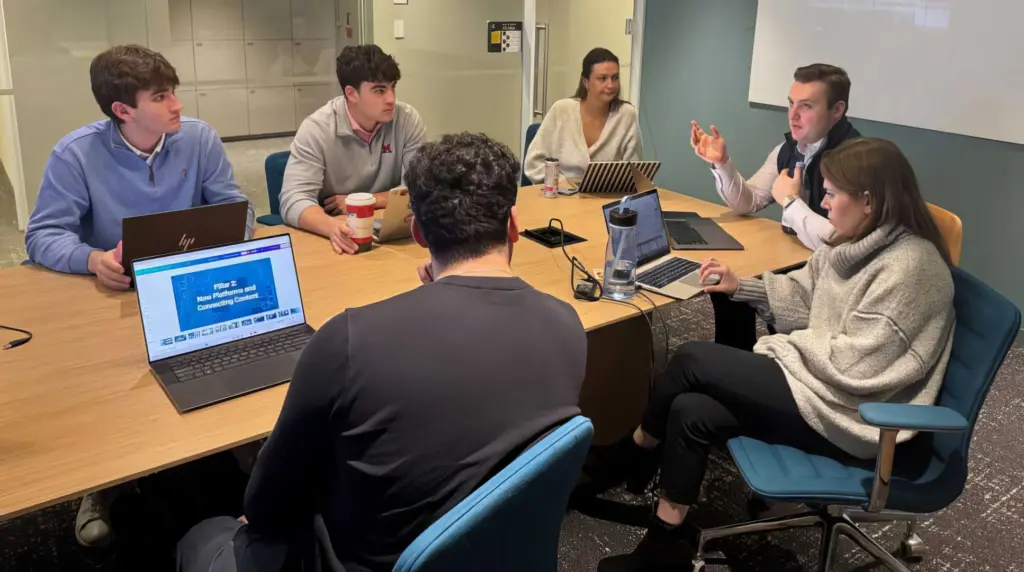
A group of Farmer School of Business students takes part in the school’s career-focused programming. Farmer’s approach is to engage students “early and often,” building professional identity, networks and career readiness throughout the undergraduate experience rather than waiting until senior year.
When you were talking earlier about engaging students “early and often,” it occurred to me that there’s so much pressure now to get on a career path very early. College used to leave more time to explore. Tell me about the chance students still have to explore.
That’s such a good question. I think about this a lot. In fact, I gave a talk to a Women in Business group the other night. There were about 200 members there, and I looked back on my own career and realized it’s completely a random walk.
If someone had told my 21-year-old self that one day I’d have a PhD, be living and working in the U.S., and be leading one of the best public undergraduate business schools in the country, I would have said, “No way.”
So I’m acutely aware of the pressure that we put our students under.
To your question, we do have a major exploration conference that we’ve done for the past two years, and we’re about to do it for a third year. We do that in the first semester of freshman year to expose students to the different major options. We believe that exposing students to choices early and often helps them.
The My Future Self platform is something I want to get in front of students at orientation so they can understand their why and not feel like they’ve failed if they don’t get a job in investment banking.
I think there’s so much pressure on students to land a first job, but it comes back to where I more or less started this conversation: We need to focus more on building you as a person and understanding who you are and where you can add value, and letting you focus beyond the first job to a career. You’ve got a lifetime in which you might end up looking at different opportunities and different roles.
When we think about 2030, we’ve launched Imagine Farmer 2030. What are we trying to aim for?
Every student has an AI-enabled career coach. Every student knows how to build with AI. Every student knows how to solve consequential problems for real organizations. Every student develops and graduates with a professional career network. Every student earns relevant credentials.
Every student graduates with verified evidence of capability—what they can do and how they can add value. And employers are deeply embedded inside our educational experience rather than simply arriving at the end of the experience to recruit.
But if those are the goals, what does success look like? What are the success metrics?
We’re really good at tracking career launch, and we’re really good at tracking starting salaries. We can measure the activities students undertake that lead to those outcomes. We’re all good at that. All business schools should be tracking that.
Where we don’t have good tracking is career progression. For me, what I would like to think—and I don’t know how we measure it, because it’s a qualitative measure—is that students feel they’re pursuing something they’re deeply passionate about.
One of the messages we give students is: Don’t just focus on building your career or your résumé. Focus on doing things you’re deeply interested in, things that light you up, that ignite you, that cause you to want to do things with vigor and passion.
If you can focus on solving problems that you’re deeply interested in, then in some ways the career will take care of itself.
Do things that match your interests, your passion, and your expertise. Because if you think back to the AI-enabled world that we’re in, your ability to solve complex problems becomes even more important.
Solve the problems that you’re interested in.
DON’T MISS: CARNEGIE MELLON RECEIVES A RECORD $3-BILLION GIFT TO BUILD A FUTURE IN MIAMI AND AT MICHIGAN ROSS, A $4.9M GRANT IS CONNECTING BUSINESS WITH CLIMATE ACTION
© Copyright 2026 Poets&Quants. All rights reserved. This article may not be republished, rewritten or otherwise distributed without written permission. To reprint or license this article or any content from Poets&Quants, please submit your request HERE.


