


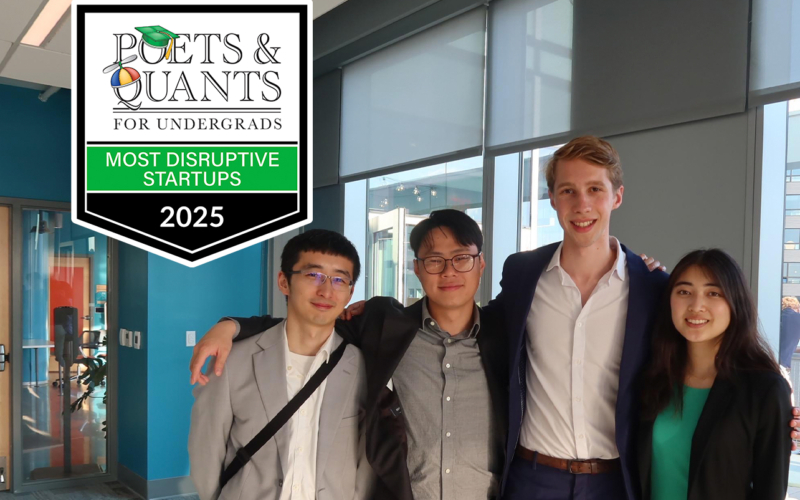
Serpent Robotics
Wharton School (University of Pennsylvania)
Industry: Robotics
Founding Student Name(s): Margaret Zhu, Steyn Knollema, Jason Li, Yiran (Kevin) Xuan
Brief Description of Solution: Serpent Robotics is revolutionizing the tree care industry with an advanced robotics system that eliminates the dangers of tree branch-cutting. Current methods, such as manual climbing and bucket trucks, are either unsafe, expensive, or terrain-limited. Serpent’s robotic system climbs trees and cuts branches while arborists operate the device safely from the ground. The design combines a lightweight ascension mechanism, a sensor suite with cameras for operator feedback, and a cutting end effector optimized for safety and control. This novel solution delivers safety, cost efficiency, and labor shortage relief for the industry.
Funding Dollars: $39,000, all of which is non-dilutive funding through several different competitions
What led you to launch this venture? We created Serpent Robotics after recognizing a massive gap in the tree care industry. Being an arborist is one of the most dangerous jobs in the U.S., yet the tools and methods used today have remained largely unchanged for decades. The more we learned about the industry, the more we wanted to make the industry safer. As we spoke with arborists and learned about their challenges, we also saw that our robotic solution could unlock enormous cost savings and address widespread labor shortages. With first-year turnover rates reaching 70%, many workers simply don’t see a future in a job that puts their lives at risk.
At the same time, we saw a unique timing opportunity. While robotics has transformed construction, agriculture, and inspection, no one was building robotic solutions specifically for cutting down tree branches. Our team’s well-rounded expertise across mechanical engineering, robotics, design, and business strategy gives us the capability, network, and drive to change the status quo. With guidance from world-class mentors such as Professor Mark Yim at Penn’s GRASP Lab and input from arborists at Harvard’s Arnold Arboretum and Penn’s Morris Arboretum, we realized we could not only innovate but redefine what’s possible in tree care.
What began as a project to improve safety has now evolved into a mission to fundamentally reshape an entire industry into one that’s safer, more sustainable, and more economically resilient.
What has been your biggest accomplishment so far with venture? Winning $20,000 from the Venture Lab Startup Challenge has been our biggest accomplishment so far. Before the competition, we were a team of students with a strong vision, but no funding to bring it to life. Since we had no physical prototype at the time, we entered with only digital renderings and CAD models. We had to persuade the panel of expert judges that our concept was both technologically feasible and commercially viable. We had to make them see what we believed in.
Winning not just one, but two awards validated our idea and gave us the confidence and resources to begin building. Those funds directly enabled us to create Serpent’s first working prototype, which can now cut branches in trees. While developing a functioning system is a huge milestone for us, it was the Startup Challenge that truly transformed us from a student team with an idea into a venture capable of real-world impact.
How has your business-related major helped you further this startup venture? I am studying Finance and Business Analytics at the Wharton School, and my degree has provided me with a broad and practical toolkit for building Serpent. On the analytical side, courses such as Strategic Cost Analysis and Valuation have helped me understand how to evaluate our business model, forecast costs and cash flows, and position the company strategically in both the short- and long-term. These skills have been invaluable as we assess product development costs, pricing strategies, and potential funding pathways.
Equally important, Wharton’s emphasis on communication and leadership has prepared me to articulate Serpent’s vision clearly. Courses in business communication and teamwork have directly shaped how I approach pitches, partnership meetings, and team coordination. I feel very fortunate to say that my Wharton education has not only given me the technical and financial foundation to make sound business decisions, but also the confidence and clarity to lead a startup through uncertainty.
Which business class has been most valuable in building your startup and what was the biggest lesson you gained from it? Business Communication (WH 2010) has been the most valuable class for building my startup. It’s an eight-person, seminar-style course taught by an experienced business professional, and it completely transformed how I approach communication. The course goes far beyond public speaking, as it also teaches how to convey ideas effectively through visual and written mediums.
These skills have been critical for Serpent Robotics because tree care is a dense field that most people know little about. A large part of my role is communicating both the “why” behind our mission and the “how” behind our technology. It’s easy to get lost in engineering details, but this class taught me how to break down complex information into clear, compelling narratives that resonate with any audience. That ability has been especially important in investor pitches and partner meetings, where clarity and genuine enthusiasm make a huge difference.
What business professor made a significant contribution to your plans and why? Professor Christopher Geczy has been a huge inspiration in shaping both my entrepreneurial mindset and the direction of Serpent Robotics. I took his course, ESG & Impact Investing (FNCE 2540), and it fundamentally changed the way I think about responsible business practices. Through his class, I learned that profitability and positive impact are not mutually exclusive. In fact, some of the best businesses achieve strong financial performance by making meaningful, sustainable changes to their business model.
This perspective directly influenced how I think about Serpent’s mission. Our work in making tree care safer and more sustainable aligns closely with the growing movement toward impact-driven investment that Professor Geczy champions. His emphasis on aligning financial incentives with measurable impact showed me that innovation in fields like robotics can and should serve both people and the planet.
What founder or entrepreneur inspired you to start your own entrepreneurial journey? How did he or she prove motivational to you? Kiichiro Toyoda. While less of a household name than Jobs or Musk, Toyoda’s legacy shaped how we think about innovation. He transformed Toyota from a small loom maker into a global automobile company renowned for its quality and innovation. He was guided by the philosophy of Kaizen, which is the process of constant, incremental improvements from everyone driving progress and quality.
When he led Toyota’s expansion into automobile manufacturing in the 1930s, many believed a Japanese company could not compete with established Western companies. Japan’s industry lacked both infrastructure and support, yet he remained committed to building quality. This meant developing better processes, communication, and collaboration across teams, an approach that evolved into the Toyota Production System (TPS), which emphasized efficiency through Just-in-Time manufacturing and built-in quality control. By prioritizing human insight over mechanical repetition, Toyoda created a culture of precision, accountability, and continuous learning that made Toyota a global standard for reliability and craftsmanship.
At Serpent Robotics, we’re inspired by Toyoda’s philosophy and resilience, especially his belief that progress comes through consistent and collaborative iteration. Like Toyota’s early years, our process is built on testing, refining, and learning from every prototype. We’ve developed multiple iterations of our system, improving performance and usability each time through close collaboration between designers, engineers, and business minds within our team. We’ve cultivated a talented and multidisciplinary group that ensures every decision incorporates technical function, user experience, and commercial viability. We hope that, just as Toyoda revolutionized the automobile industry, we can revolutionize the tree care industry.
What is your long-term goal with your startup? Our long-term goal is to establish Serpent Robotics as an industry disruptor in tree care, where every arborist views our system as essential equipment, just as chainsaws replaced hand saws in the 20th century.
Beyond tree care, our vision is to become the global leader in rope-suspended robotics for dangerous vertical work. After proving our platform in arboriculture, we would like to adapt it for offshore wind turbine maintenance, power line inspection, skyscraper facade repair, telecommunications tower servicing, and any other environment where humans currently face 100-foot drops and high risk. Our long-term vision includes transitioning from remote-operated to increasingly autonomous systems where one skilled operator could supervise multiple robots, focusing on judgment and strategy while robots handle dangerous execution.
Ultimately, Serpent Robotics aims to be remembered as the company that made dangerous vertical work safe and accessible, just as JCB and Caterpillar transformed ground-level construction, and Boston Dynamics advanced legged robotics. For us, working on Serpent isn’t just about building a successful business or building cool robots; it’s about fundamentally changing the risk-reward calculus in industries where people currently trade their safety for their livelihood, so workers can go home safely every day.
How has your local startup ecosystem contributed to your venture’s development and success? Serpent Robotics would not exist without the support of UPenn’s startup ecosystem. Our journey began with the Mack Institute’s Y-Prize Competition, which provided our first $1,500 in funding and connected us with advisors from Penn’s GRASP Lab, who guided us through early technical and design challenges.
We’ve also been deeply supported by Venture Lab, which is Penn’s entrepreneurship hub. As we mentioned earlier, winning the Startup Challenge was absolutely game-changing. It gave us the funding and confidence to keep building. It’s also the reason multiple members of our founding team were able to work on Serpent full-time over the summer instead of treating it as a side project. We’re now part of VIP-X, Venture Lab’s accelerator program, and it’s been wonderful to have a cohort of founders to meet with every week, alongside the mentorship and support that comes with the program.
In addition, Penn I-Corps taught us how to conduct customer discovery and build early traction, and the Pennovation Accelerator provided both funding and hands-on mentorship.
Truly, we owe so much of our progress to the Penn ecosystem. From funding to mentorship to community, these programs have been instrumental in helping us turn Serpent from a student idea into a real company with real impact.
DON’T MISS: MOST DISRUPTIVE BUSINESS SCHOOL STARTUPS OF 2025
© Copyright 2026 Poets & Quants. All rights reserved. This article may not be republished, rewritten or otherwise distributed without written permission. To reprint or license this article or any content from Poets & Quants, please submit your request HERE.


